

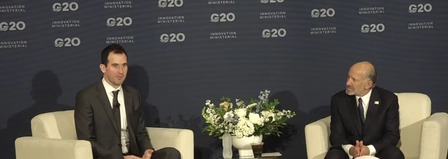
Chapel Hill (North Carolina), Sep 2 (IANS) Anthropic Executive Tom Brown has urged G20 countries to clear the way for data centres, warning that shortages of power and construction labour have become the biggest constraint on the rapid expansion of artificial intelligence (AI).
In a fireside conversation with US Commerce Secretary Howard Lutnick, Brown said that AI demand was growing exponentially and creating an industrial expansion larger than the railway boom of the 19th century.
“We have this incredible industrial build out of likes of which we’ve never seen in the history of humanity more than the railroads of the 1800s,” he added.
“And so, that’s a place where any country that wants to be involved has a chance to be involved.”
Lutnick asked what infrastructure countries needed to participate in the economic benefits expected from AI.
“I think that the biggest thing by far is building more, making it possible to build more data centres, more compute in your countries,” Brown said.
“It’s very clearly the bottleneck for all of our progress. We’re in a huge shortage of the power and labour needed to support the demand for AI.”
Brown said data centres could generate employment, government revenue and new investment.
He added that their design could also add electricity to national grids.
“The biggest things that we need in order to build data centres are we need permitting for land to be able to build there,” he said.
“And then we need to figure out how to get enough labour to do the construction there as well.”
Lutnick encouraged governments to make themselves attractive destinations for technology investment.
“If your country rolls out the red carpet to great investment, they’re more likely to have that investment than if it’s a fight to get in,” the Commerce Secretary said.
Brown identified two broad economic gains from AI. The first was reindustrialisation driven by large investments in physical infrastructure. The second was an expansion of the effective workforce available for intellectual tasks.
“The key component of the overall economy is how many smart people do we have doing good work?” he said.
“The AIs now are, like, not quite people, but they’re doing intellectual labour also.”
Brown said that AI models were progressing quickly in software engineering, mathematics and scientific work. He predicted they could accelerate research into diseases, including cancer.
“I think there’s no doubt that if we have, like, a million times more oncology researchers, we could make progress that’s not just, like, 10 per cent faster,” he added.
“It would be, like, multiples faster.”
The economic value created by frontier AI laboratories was growing fourfold annually, Brown said.
That amounted to a doubling every six months, he added.
“There’s never been an industry of this size that’s been growing at that speed,” he said.
The cost of accessing a model comparable to the leading model a year earlier was now roughly 20 times lower, he added.
Brown said governments and businesses would derive greater benefits if they treated AI models as collaborators and gave them the documents, tools and permissions needed to perform assigned work.
He also described a global commercial opportunity for companies capable of adapting general-purpose models to specialised fields such as law, biology and mechanical engineering.
Anthropic was founded in 2021 by former OpenAI researchers.
The US artificial intelligence company develops the Claude family of models and has placed a strong emphasis on AI safety, reliability and responsible deployment.
The global expansion of AI has increased demand for data centres, advanced semiconductors and electricity.
Governments, including India, are seeking greater computing capacity while also confronting questions about energy supplies, land, water use, and the skills required to build and operate the new infrastructure.
–IANS
int/lkj/khz