
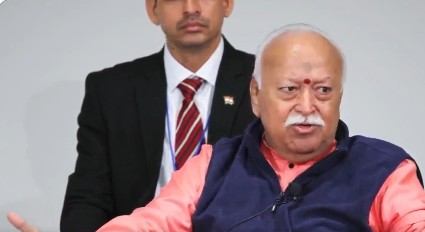
New York, Aug 30 (IANS) Rashtriya Swayamsevak Sangh (RSS) Chief Mohan Bhagwat has outlined a long-term global outreach strategy built around interfaith dialogue, non-discriminatory service and local cooperation, while saying that social movements must shape public opinion before attempting to influence political decisions.
His address to the “One World, One Humanity” gathering in New York went beyond a broad appeal for religious harmony. It set out how the RSS believes that harmony can be pursued: begin within society, combine dialogue with service, create working models at the community level and continue the effort even when results are slow.
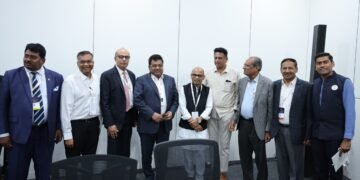
The gathering brought together more than 180 religious leaders and participants from 30 countries. Speakers representing Christian, Jewish, Muslim, Hindu and other traditions called for cooperation against war, hatred, poverty and religious persecution.
Bhagwat positioned the RSS as a partner in that effort.
“RSS with all its might is always with you because we are on the same page,” he said.
“The starting point of his argument was the idea that religions may differ, but humanity remains one. People describe the same truth in different ways because their experiences and perceptions vary,” the RSS Chief said.
“I am working in a society which traditionally says that religions might be different but humanity is one,” Bhagwat added.
He distinguished between the destination offered by religion and the rituals used to reach it.
Rituals were necessary to maintain spiritual discipline, he said, but they should not distract followers from religion’s central purpose.
“What for religion is there? It is leading us to truth,” the RSS Chief said.
Bhagwat compared religious practices to a finger pointing towards a light.
A person who remained focused on the finger would fail to see the light it was indicating, he said.
“Paths are bound to be there and they are bound to be many because there is a difference between our perception,” Bhagwat added.
This philosophical argument formed the basis for the RSS chief’s call to protect religious pluralism.
“Diversity is a decoration for our innate unity,” Bhagwat said.
“It has to be accepted. It has to be respected. It has to be protected.”
“As I protect my own specific nature, I have to protect others also,” he said.
“Because diversity is the rule of nature. Unity is the truth behind it.”
The second major element of the address was service. Bhagwat said interfaith dialogue could not remain confined to conferences or statements. It had to be accompanied by practical work from the beginning.
“Dialogue is the first step. Service is another. Not one step after that. It had to start simultaneously,” the RSS Chief added.
He said that RSS volunteers, with support from society, operated 130,000 service projects of different sizes.
Those initiatives helped people without considering their religious identity, he added.
“Whoever is needing, we are serving,” Bhagwat said.
“And they serve everywhere, they serve equally.”
He cited the response to a collision involving two aircraft over Haryana.
Most of the passengers were Muslim, he said, but RSS volunteers who reached the site did not consider their religion while recovering bodies, assisting the wounded and helping relatives.
“We never thought at that time that these are Muslims,” Bhagwat said.
He linked that approach to the RSS’ stated distance from electoral politics.
“We could do this because we are not in politics,” he said.
“We do it. We only give. We don’t want anything.”
The address, however, did not suggest that religious and social organisations should remain detached from policymaking.
Bhagwat said they eventually needed to influence governments, including in efforts to prevent wars. His argument was that they should first build social strength and public support.
“These things do not happen through politics. Sorry to say, but the fact is, politics has now become a game of self-interest,” he added.
“We and ours is the solution. So our experience in Bharat is that we have to start with the society,” Bhagwat said.
He added that democratic politics responded to public opinion.
Creating a social consensus was therefore the most effective route to changing government policy, he said.
“If there is public opinion, then no politician will dare to go against it,” the RSS Chief added.
The third component of his approach was decentralisation. Bhagwat asked religious leaders to take dialogue beyond international gatherings and senior institutions.
“Whatever we decide to do today, we should start in our own country and create pockets of such selfless service, such atmosphere of unity,” he said.
“We should create at our own place the models of the world we want,” he added.
Those local models should be linked through continuing dialogue, he said.
Engagement should eventually extend to provinces, districts and blocks so that relationships between communities were built from the ground up.
The final element was persistence, Bhagwat said.
In his remarks, the RSS Chief acknowledged that dialogue might not produce immediate or easily measurable results.
He referred to continuing engagement with Muslim and Christian communities in India following a speech he delivered in Delhi in 2018.
“So we started that dialogue. Mainly with Muslims and Christians of Bharat,” he said.
“And step by step we are going ahead.”
Bhagwat said knowledge of goodness and love already existed in religious traditions.
“The harder task was turning it into habitual conduct capable of resisting the attractions of wealth, influence and superiority.”
“We have to instill the practice,” the RSS Chief said.
“If we together start working, we can change the situation of the world,” Bhagwat added.
“But it will take long time.”
The Rashtriya Swayamsevak Sangh was founded by K.B. Hedgewar in Nagpur in 1925 and completed its centenary in 2025. It describes itself as a volunteer-based cultural organisation, with a nationwide network of local branches and affiliated bodies working in social service, education, labour and other fields.
Mohan Bhagwat, a Veterinary Sciences graduate, became the organisation’s sixth Sarsanghchalak (Chief) in 2009.
As the RSS chief, Bhagwat provides its broad ideological and organisational direction and has in recent years participated in outreach and dialogue with representatives of different religious communities.
–IANS
int/lkj/khz