
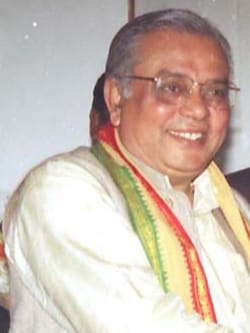
New Delhi, June 2 (IANS) On this day in 2014, Tapan Sikdar, the Bharatiya Janata Party (BJP) stalwart who scripted history by winning the Dumdum Lok Sabha constituency twice, the first party leader to do so in West Bengal, passed away in New Delhi after a prolonged illness.
The name is relevant now, with renewed efforts to relocate a mosque, reportedly 136 years old, from within the operational area of Netaji Subhas Chandra Bose International Airport in Kolkata. Sikdar had long advocated its removal to facilitate runway expansion and modernisation, ensuring aviation safety. His intervention in the Lok Sabha was a significant factor in ongoing discussions to address the mosque’s location.
Recounting this, his nephew Sourav Sikdar has taken it upon himself to address the issue and push for the expansion of the airport, which has significantly lost international connections since the Left Front’s rule. Dumdum’s political narrative has thus acquired a new chapter.
In a twist of coincidence, Sourav’s maiden electoral victory came from an Assembly segment that falls within the Dumdum Lok Sabha constituency, Dum Dum Uttar. Located in North 24 Parganas, Dumdum is home to the airport, military cantonments, and dense urban settlements.
The elder Sikdar’s victories here in 1998 and 1999 were historic. He became the first BJP leader to win a Lok Sabha seat in West Bengal, breaking through in a state long dominated by the Left Front and later the Trinamool Congress.
He was Union Minister of Communications and Information Technology and later Union Minister of State, Ministry of Chemicals and Fertilisers in the Prime Minister Atal Bihari Vajpayee-led National Democratic Alliance (NDA) government.
His tenure as MP was marked by emphasis on infrastructure, law and order, and national security. Dumdum, with its airport and defence establishments, was a natural constituency for such concerns.
His speeches often linked local issues to national priorities, whether it was the airport runway or the need for better civic amenities in the industrial belts of North 24 Parganas. Sourav recalls his uncle’s intervention in the Lok Sabha, demanding the removal of the mosque, arguing that the structure posed a safety hazard to aviation and symbolised the state’s reluctance to confront sensitive matters.
Even then, answering a question on November 18, 2002, the then Minister of State for Civil Aviation, Shripad Yesso Naik, stated in the Lok Sabha that the mosque in airport premises “is falling under the developmental plan and extension of the second runway”.
He pointed out that the Airports Authority of India (AAI) had taken up the issue with the state government, then under the Left Front, for shifting the mosque.
Naik added that “decision regarding the shifting of the mosque is yet to be taken, including on whether the mosque will be relocated on AAI land or on land belonging to the state government”.
However, lack of political will on the part of subsequent state governments, largely over the intersection of faith, infrastructure, and politics in West Bengal, kept its shifting in abeyance.
Tapan Sikdar’s interventions in Parliament, whether about the airport mosque or broader issues of governance, stemmed from his intent to modernise and integrate. Sourav’s entry into the Assembly reflects a more localised battle, where civic issues, neighbourhood concerns, and party organisation matter as much as national narratives.
The symbolic link makes Dumdum a stage where the BJP first tested its Parliamentary strength in Bengal. For the Sikdar family, it remains both a political base and a legacy.
–IANS
jb/dan