
Dhaka, July 19 (IANS) Bangladesh continues to face concerns regarding the spread of extremist narratives in public discourse. Extremist messaging does not rely only on underground organisations or physical networks. Instead, people and groups use social media platforms to spread misinformation and conspiracy theories, a report has detailed.
The issue of violent extremism has gained attention after Bangladesh Prime Minister Tarique Rahman’s statement in Jatiya Sangsad on July 15 said that his government would maintain “zero tolerance” towards extremism and militancy. However, the challenge extends beyond any single government or political period, according to a report in Bangladesh-based Daily Sun.
For a nation which wants sustained economic growth and foreign investment, stability is not only a political objective but an economic requirement as investors consider infrastructure, market opportunities, institutional strength, public security and confidence in the rule of law.
“Bangladesh continues to face concerns over the spread of extremist narratives in public discourse. The challenge has now expanded into the digital world. Extremist messaging no longer depends only on underground organisations or physical networks. Social media platforms allow individuals and groups to rapidly spread misinformation, inflammatory messages and conspiracy theories, sometimes transforming online anger into real-world mobilisation,” the Daily Sun report mentioned.
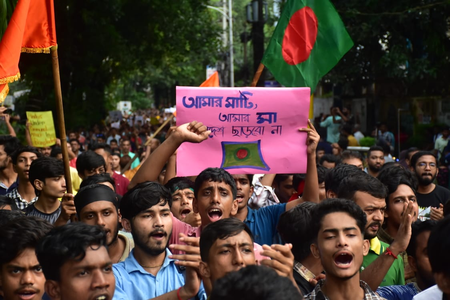
It added that the influence of online platforms became particularly visible during unrest following the killing of Inquilab Mancha spokesperson Osman Hadi in December 2025. Public anger surrounding the incident was amplified through online mobilisation, contributing to attacks and vandalism targeting a diplomatic mission, cultural institutions and media organisations.
Cultural institutions in Bangladesh face pressure from extremist elements, with organisations such as Udichi and Chhayanaut, which represent the country’s cultural heritage and pluralistic traditions, repeatedly facing hostility from groups seeking to reduce the space for cultural expression and public debate.
Earlier in June, a leading international human rights organisation strongly condemned the suspension of the construction of an 81-foot-tall statue of Lord Ram at the Sri Sri Radha Govinda and Kali Temple in Gaibandha district of Bangladesh, under pressure from Islamist extremists.
Citing reliable sources, Justice Makers Bangladesh in France (JMBF) said that the project was halted amid pressure from Islamist extremist groups, fears of possible mob violence, and growing concerns over the security of the Hindu minority community.
Expressing grave concern, the JMBF said that this incident “constitutes a clear violation of the rights to freedom of religion, freedom of expression, and the security and rights of religious minorities as guaranteed by the Constitution of Bangladesh, the Universal Declaration of Human Rights (UDHR), and the International Covenant on Civil and Political Rights (ICCPR).”
The rights body noted that after the initiative to construct the Ram statue became public in early June this year, local Islamist groups and several others launched a series of protests, held press conferences and demonstrations, and submitted memoranda to the local administration opposing the project. Subsequently, under mounting pressure, the temple authorities on June 12 officially announced the suspension of the construction work.
JMBF also voiced concern that several mainstream media outlets in Bangladesh had published only limited or incomplete information regarding the incident.
“Fearing possible mob violence, reactions from extremist groups, and risks to journalists’ safety, some media organisations have reportedly resorted to self-censorship. This raises serious concerns regarding the public’s right to information and freedom of the press,” it added.
–IANS
akl/dan