
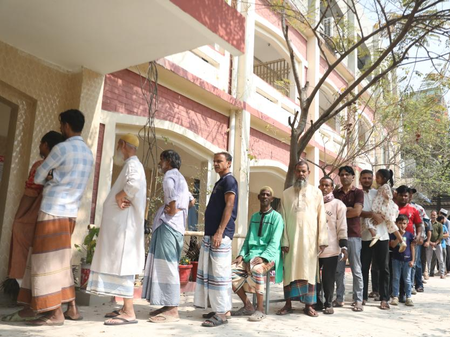
New Delhi, Feb 13 (IANS) The Bangladesh Nationalist Party (BNP) won the elections with a thumping mandate. On February 12, the country voted for the first time since the uprising that led to the ouster of Sheikh Hasina. Simultaneously, the people of Bangladesh were asked to decide on a constitutional reform package under the “July National Charter” (Constitutional Amendment) Implementation Order 2025.
Local media reports said that a majority of the participating voters supported the reform package. One report said that 73 per cent of the counted votes said ‘Yes’ to the referendum. However, an official announcement is yet to be made regarding the results of the referendum.
Currently, the country has a parliamentary system. If the referendum is approved, then a second chamber called the Upper House would be established. This would have 100 seats allocated proportionally based on the vote share of the parties in the general elections. This would mean that Constitutional amendments would need to be approved by both Houses. A two-thirds majority in the lower house and a majority vote in the Upper House would be necessary for the amendments to go through.
Further, the impeachment of the President would need two-thirds support in both chambers. Once implemented, it would be mandatory to have the deputy speaker of the lower party from the opposition. Reserved seats for women would be gradually increased to 100. Any major international treaty involving national security would need approval of both Houses.
The package would reinstate the caretaker government system, which had previously been abolished. The formation of such a government would be subject to the consensus of the ruling party, the opposition and the second opposition party.
While Muhammad Yunus, the caretaker of the interim government, called the reform path-breaking, many are sceptical about it.
There are a number of proposals which could overturn the basic constitutional principles.
The referendum, according to experts, is an attempt to change the Constitution. This means that the continuity of the Constitution comes to an end after almost 55 years. Further, there is no provision for a plebiscite, even if it meant that the government had got it signed by the President of Bangladesh.
According to media reports, a majority of the people of Bangladesh have voted in favour of the implementation of this reform. This means that the government is obligated to implement it.
The implementation would lead to the establishment of a bicameral Parliament. Experts are questioning this move as the Constitution does not allow this. There is likely to be a legal challenge to this, and the matter may drag on in court until a final decision is taken.
Bangladesh, since its formation in 1971, has seen three referendums –1977,1985 and 1991.
The 1977 and 1985 referendums were held under military rule, while the one in 1991 took place to create the provision for a caretaker government, which would ensure the conduct of national elections.
All three referendums of the past got the support of 84.38 to 98.88 per cent of the people.
The first two referendums asked the people if they had confidence in the sitting president and his policies. The third one sought the approval to shift from a presidential system back to a parliamentary democracy.
The experts also argue that if one looks closely at the reform, there are attempts being made to erase the 1972 Constitution of Bangladesh. The very foundation of the country will be under threat if this reform were to go through.
Yunus has, however, pushed hard for this reform. This reform also recognises the interim government that he headed. He is making an effort to cement his legacy, which in reality has been marred by violence. On February 9, Yunus, during a nationwide address, made a call seeking a “Yes” vote for his proposed package. He said that if the “Yes” vote wins in the referendum, Bangladesh’s future will be built in a more positive way. He also said that the referendum represents a move towards a civilised society from barbarism.
–IANS
vn/dpb