

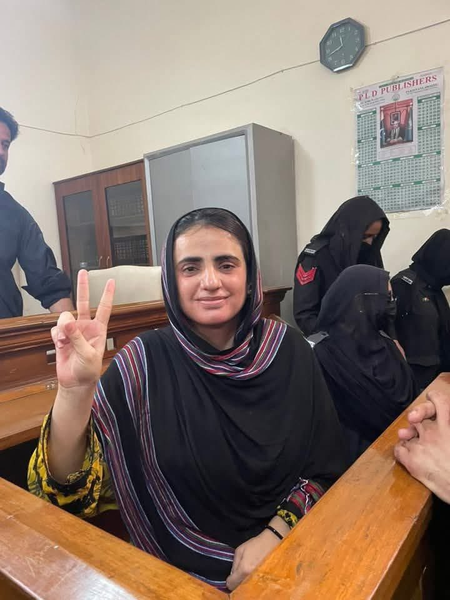
Islamabad, July 5 (IANS) An anti-terrorism court in Pakistan’s Quetta sentenced Baloch activist Mahrang Baloch to life imprisonment, sparking criticism from international human rights organisations and reigniting concerns over the trajectory of the rule of law in the country. However, the case has demonstrated how Pakistan’s “Hard State” doctrine is evolving from a counterterrorism strategy into a broader model of governance, a report has detailed.
This transformation did not take place overnight. In 2025, Pakistan’s Chief of Army Staff, Field Marshal Asim Munir, publicly spoke about introducing the concept of the “Hard State,” contending that Pakistan needed a stronger and more decisive state to confront terrorism, restore internal security, and reinforce state authority. Four days later, Mahrang Baloch was arrested during a police raid on a peaceful sit-in in Quetta, and the court recently sentenced her to life imprisonment. The sequence of these events sparks a question.
“The ‘Hard State’ doctrine was introduced as a response to armed militancy. Yet within little more than a year, some of its most visible applications have involved internationally recognised human rights defenders rather than armed militant organisations. The central question, therefore, is not simply whether Pakistan’s ‘Hard State’ can strengthen national security,” Dimitra Staikou, Greek lawyer and human rights advocate, wrote in a report in the European Times.
“It is whether such a doctrine can remain compatible with the institutional credibility that Pakistan seeks to preserve in its relations with the European Union and other democratic partners. The first major test of Pakistan’s new security doctrine did not involve an armed militant organisation. Instead, it centred on one of the country’s most prominent human rights advocates,” she added.
At the time of arrest, Mahrang Baloch was far from an obscure public figure. She featured in TIME magazine’s TIME100 Next list in October 2024, and the BBC named her among its 100 Women in December 2024, recognising her work documenting enforced disappearances and advocating for victims of human rights abuses in Balochistan. On June 22, 2026, an anti-terrorism court sentenced her to life imprisonment on charges related to terrorism.
“The prosecution alone cannot determine how Pakistan’s “Hard State” doctrine is being implemented. It does, however, represent the first and most emblematic case through which the doctrine’s practical application can be examined. More importantly, it raises a question that extends well beyond a single judicial proceeding: where does the boundary lie between legitimate counterterrorism policy and the criminalisation of peaceful political dissent? The significance of that question becomes even greater when this case is viewed alongside a growing number of prosecutions involving lawyers, civil society leaders, and other human rights defenders,” Dimitra Staikou wrote in the report of the European Times.
“Considered together, these developments invite a broader examination of whether Pakistan’s evolving security doctrine is being applied solely against violent extremism or is gradually reshaping the relationship between national security, civil liberties, and the rule of law. The prosecution of Pakistan’s most prominent Baloch activist does not appear to be an isolated development. Rather, it forms part of a broader pattern in which lawyers, civil society leaders, journalists, and human rights defenders have increasingly faced severe criminal charges, often under legislation originally designed to combat terrorism and protect national security,” the author added.
The trend is also demonstrated in the case of human rights lawyers – Imaan Zainab Mazari-Hazir and her husband, Hadi Ali Chattha, who were arrested in January and subsequently sentenced to 17 years in prison. Mazari had been among the most outspoken lawyers demanding the release of Mahrang Baloch. While remaining in detention, Imaan Zainab Mazari-Hazari and Chattha were awarded the Ludovic Trarieux International Human Rights Prize in June 2026. These cases are no longer seen as domestic judicial matters but are being viewed in the world as indicators of Pakistan’s broader institutional trajectory, according to the report.
Earlier in June, UN Special Rapporteur on the situation of human rights defenders, Andrea Bolanos Vargas, expressed serious concern over the life sentences handed down to Baloch Yakjehti Committee (BYC) leaders Mahrang Baloch and Sibghatullah Shah Ji, calling on Pakistan’s judiciary to overturn what she described as “unjust convictions.”
She cited multiple alleged violations during the proceedings, including denial of fair trial and due process, abuse of antiterrorism laws, criminalisation of peaceful assembly, and double punishment for the same act.
“I express grave concern regarding life sentences imposed on WHRD Mahrang Baloch and Sibghatullah Shah, leaders of the Baloch Yakjehti Committee, by the Anti-Terrorism Court in Quetta in a secret trial. Violations Identified: denial of fair trial, abuse of antiterrorism laws, criminalisation of peaceful assembly, due process, and double punishment for the same act. I urge the superior judiciary to overturn manifestly unjust convictions,” Vargas posted on X.
–IANS
akl/uk