
Gandhinagar, Aug 3 (IANS) Agricultural scientists and horticulture officials have begun visiting flood-affected farms across South Gujarat to help growers restore uprooted fruit trees, with experts saying that many horticultural trees can be saved if their roots remain connected to the soil and are treated using scientific methods.
The field initiative follows heavy rainfall across the region, which has damaged orchards in several districts.
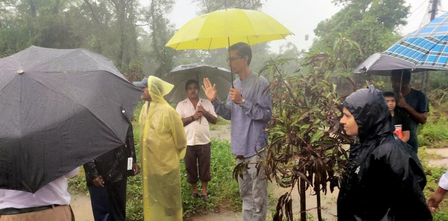
Acting on the directions of State Agriculture Minister Jitu Vaghani, joint teams from the State Horticulture Department and Navsari Agricultural University have been visiting affected villages since last Friday to provide hands-on demonstrations on restoring uprooted trees and managing them after replanting.
Despite continuous rainfall and without waiting for floodwaters to recede, the teams have been working in Valsad, Navsari, Surat, Dang and Tapi districts, training farmers directly in their fields on techniques to minimise long-term crop losses.
Agricultural experts said that uprooted saplings and trees whose roots remain attached to the soil can often be revived through proper scientific care, helping farmers protect orchards built up over many years.
Progressive farmer Mohan Patel of Ghej village in Navsari said the same approach had proved successful after Cyclone Tauktae.
Recalling his experience, he said several small and large mango trees in his orchard had been uprooted during the cyclone.
With guidance from scientists of the Horticulture Department and Navsari Agricultural University, he attempted to restore them.
“As a result, nearly 70 to 80 per cent of the uprooted mango trees recovered successfully, and today it is difficult to even identify which trees had once fallen,” Patel said.
He added that farmers could save orchards developed over years of hard work if they adopted scientific methods instead of abandoning damaged trees after floods or cyclones.
Dr Ankur Patel, Associate Research Scientist at Navsari Agricultural University, advised farmers not to lift uprooted saplings abruptly, as doing so could damage their roots.
Instead, he recommended raising the tree slowly, pausing briefly after partially lifting it before continuing until it is upright.
He also advised pruning long and drooping branches to reduce the tree’s nutrient demand after flood damage, leaving only a limited number of leaves so that new shoots can develop.
The exposed surfaces of pruned branches should be treated with a Copper Oxychloride (COC) paste to prevent rotting and encourage fresh growth.
For soil and root treatment, Dr Patel advised against applying cow dung manure immediately after flooding during the monsoon.
Instead, he recommended mixing 50 grams of Carbendazim powder with one kilogram of vermicompost, turning the mixture for four to five days before applying it around the base of the tree.
To prevent root rot, he suggested drenching the soil with a solution prepared by mixing one kilogram of Trichoderma viride and two kilograms of urea in 200 litres of water, applying one litre of the solution to each sapling two to three times a month.
Dr Patel also advised farmers to prepare for future monsoons by constructing protective bunds at least two feet high around saplings before the rainy season, taking into account the direction of water flow from nearby rivers or streams.
Such bunds, he said, help protect young trees from flowing water, provide additional support and reduce the risk of uprooting during heavy rainfall.
–IANS
mys/rad