
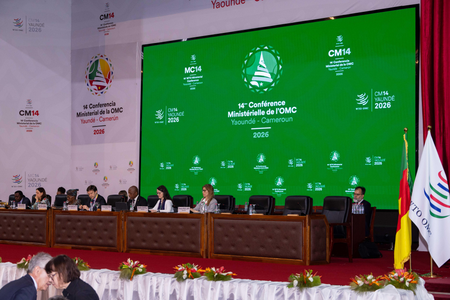
New Delhi, March 29 (IANS): Ministers and senior officials attending the WTO’s 14th Ministerial Conference (MC14) in Africa’s Cameroon participated in a series of meetings to address key issues on the WTO agenda and to provide political direction for the post-MC14 work ahead, according to a statement issued by the multilateral body.
The ministerial sessions addressed the issues of fisheries subsidies, the Investment Facilitation for Development (IFD) Agreement, the E-Commerce Work Programme and moratorium, agriculture, and development, including issues relevant to least developed countries.
The ministerial sessions were preceded by a report from the Chair of the WTO’s Dispute Settlement Body (DSB), Ambassador Clare Kelly of New Zealand, who provided an update on the discussions concerning dispute settlement reform.
Ambassador Kelly noted that she held two rounds of consultations with members on the issue in July and November 2025, respectively, on how to advance the discussions. In those consultations, members overwhelmingly reaffirmed that dispute settlement reform is a priority, she said. At the same time, she added, many members recognised the current difficult context surrounding dispute settlement reform and supported the resumption of work after MC14 once the time is right and members are ready.
At the Ministerial Session on Fisheries Subsidies, facilitated by Atty Asis G. Perez, Undersecretary at the Department of Agriculture of the Philippines, WTO members praised the entry into force of the WTO Agreement on Fisheries Subsidies and welcomed the deposit of instruments of acceptance by Paraguay, Samoa, and Saint Vincent and the Grenadines on March 26. To date, 119 WTO members have formally accepted the Agreement.
India said it remains committed to negotiating a comprehensive Fisheries Subsidies Agreement that balances current and future fishing needs, protects the livelihoods of poor fishers, with appropriate and effective Special and Differential Treatment (S&DT).
Members also reaffirmed their commitment to continue negotiating on outstanding fisheries subsidies issues with the aim of finding consensus on additional provisions to further strengthen the disciplines on fisheries subsidies.
The session on the IFD Agreement was facilitated by Dwright Fitzgerald Bramble, Minister of Foreign Affairs, Trade, Investment and Diaspora Affairs of Saint Vincent and the Grenadines. Members reviewed prospects for incorporating the IFDA into the WTO legal framework.
However, India maintained that investment is not a trade issue under the Marrakesh Agreement establishing the WTO and cautioned against the use of plurilateral agreements to sideline outstanding multilateral mandates.
At the session, Bangladesh announced its decision to join the IFDA, bringing the total number of the Agreement’s co-sponsors to 129.
The session on electronic commerce was facilitated by Kamina Johnson Smith, Minister of Foreign Affairs and Foreign Trade of Jamaica. The facilitator provided an outline of elements that could comprise a possible package on e-commerce, based on consultations with members. These elements include reinvigorating e-commerce discussions through the Work Programme on E-Commerce or through a new Committee on Digital Trade, strengthening the development dimension of e-commerce efforts at the WTO, and continuing a moratorium on customs duties on electronic transmissions for which members need to decide the duration. Members took the floor and provided their views on these elements.
At the close of the session, the facilitator noted that members had moved towards convergence. However, she noted that members’ positions have yet to fully converge. More discussions would be convened after the session, she said, adding that e-commerce is an important issue for growth and development and relevant to all members’ futures.
The session on agriculture featured a robust discussion among members covering issues ranging from market access, food security and public stockholding to special safeguard measures. Most members expressed their desire to continue discussions on substantive matters back in Geneva.
India took the stand that agriculture is critical to the livelihoods of millions. For the Global South, a permanent solution on public stockholding for food security purposes, a special safeguard mechanism, and cotton are long-pending mandated issues which must be delivered on priority.
–IANS
sps/vd