
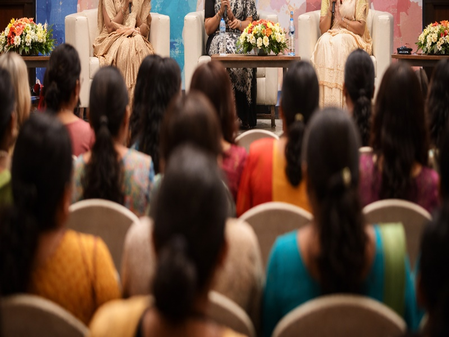
New Delhi, Feb 26 (IANS) The Chintan Research Foundation hosted an event titled Empowered Women, Developed India in the national capital, bringing together policymakers, diplomats, economists and other experts to discuss the vital role of women in building a developed India by 2047.
The gathering underscored that true national progress remains incomplete without the full and active participation of women across social, economic, political and institutional spheres.
Prominent attendees included Deepti Mohil Chawla, Additional Secretary in the Ministry of Defence; former Indian High Commissioner Veena Sikri; and Shamika Ravi, a member of the Prime Minister’s Economic Advisory Council.
Each shared insights on pathways to genuine empowerment and highlighted persistent structural and societal barriers.
Deepti Mohil Chawla emphasised that the vision of a developed India by 2047 is closely linked to women’s empowerment and greater participation in national development.
She outlined three key pillars supporting this goal. First, India’s constitutional and legal framework guarantees equality, equal opportunities and protection for women. Second, leadership initiatives and government schemes have sought to enhance women’s participation across sectors, from grassroots governance to higher levels of political and institutional representation. Third, societal attitudes are gradually evolving, enabling women to move beyond traditional constraints and assume roles in sectors such as defence, law, and governance.
She noted that women are increasingly taking on operational responsibilities in the armed forces and leadership roles in judicial and legal institutions, reflecting a gradual shift in opportunities and social perceptions. However, she added that such progress has not yet reached all sections of society.
Veena Sikri said such discussions are important in the present context and stressed that sustainable development cannot be achieved without women’s full participation.
She highlighted that government initiatives such as the “Beti Bachao, Beti Padhao” campaign and the Pradhan Mantri Ujjwala Yojana have contributed to improving women’s welfare and access to opportunities.
However, she emphasised that beyond legislative and policy measures, there is a need to address deep-rooted social attitudes that continue to limit women’s empowerment.
She observed that patriarchal mindsets remain a challenge, affecting women’s access to opportunities and undermining their confidence and autonomy despite educational and professional progress.
From an economic perspective, Shamika Ravi noted that women contribute significantly to economic activity, although a substantial portion of their work, particularly unpaid domestic labour, remains unrecognised in formal economic assessments.
She emphasised the need for policies that recognise women’s contributions and support their participation through institutional and social measures.
She added that ensuring visibility and recognition of women’s economic contributions is essential for achieving inclusive and sustainable development.
The event highlighted the importance of empowering women as a key component of India’s broader development strategy and its long-term vision of becoming a developed nation by 2047.
–IANS
sktr/pgh