

New Delhi, Feb 25 (IANS) The Union Ministry of Home Affairs (MHA) has unveiled ‘PRAHAAR’ — India’s first national counterterrorism policy and strategy, outlining the nation’s zero-tolerance towards acts of terrorism, from outside and inside.
The elaborate document lays out a framework for India’s firm approach to terrorism, steps already taken over the years, and articulates the strategy to be adopted in future.
For decades, the country has suffered multiple blows due to terrorism, sponsored from across the border and Jihadi outfits along with their frontal outfits fomenting terror in the Indian territory. For years, they continued to plan, coordinate, facilitate and execute terror attacks in India, with global terror groups like Al Qaeda and the Islamic State of Iraq and Syria (ISIS) attempting to spread terror in the country through their sleeper cells.
And, all that India did during these years in response to the cross-border terrorism was to prepare dossiers, diplomatic protests, and make repeated appeals to the international community.
However, with PRAHAAR taking shape, this redefines the government’s approach and strategy in taking the terror proxies and their masters head-on, reiterating India’s new zero-tolerance approach in dismantling terror networks and neutralisation of sleeper cells, backed by global outfits.
This strategic reset was visible in two recent anti-terror operations. In Jammu and Kashmir’s Kishtwar, a top Jaish-e-Mohammad (JeM) commander was neutralised, while in Tamil Nadu, an ISI-backed sleeper cell was dismantled. They reflect a new, institutionalised counter-terrorism doctrine, as articulated in PRAHAAR.
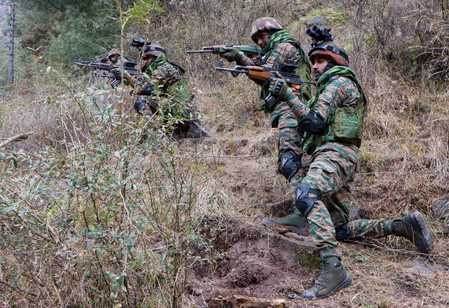
In J&K’s Kishtwar, the security forces undertook a 36-hour-long operation Trashi-I in the dense, inhospitable forest of Chatroo, showcasing a masterclass in India’s evolved military capabilities. A top JeM commander named Saifullah was gunned down along with two foreign mercenaries.
The security forces’ calibrated response in neutralising these terrorists while making optimal use of intelligence gathering and drone surveillance marked a new strategic shift in anti-terror strategy. The security forces utilised real-time drone surveillance and specialised K9 units to flush out terrorists from the hideouts in the difficult terrains of Kishtwar.
This showed India’s firm determination that terror proxies will no longer get a sanctuary in the valley, and if pushed from across the border, the repercussions will be too high to bear.
In Tamil Nadu’s Tiruppur, eight operatives of ISIS, primarily Bangladeshi nationals, were nabbed, exposing the dangerous and wicked designs of ISI’s hybrid war.
With the module’s handler based in Bangladesh, it sought to infiltrate the labour-intensive industries across the country by forging identity documents and plotting IED attacks in crowded areas with high footfall.
The integration of the multi-agency centre (AMC) has proved instrumental in security agencies tracking down the sleeper cells and making them obsolete.
The eight-page policy, uploaded on the MHA portal, states that India faces terrorist threats on all three fronts, viz., water, land and air and adds that the capacities have been developed to protect critical sectors of the Indian economy, including power, railways, aviation, ports, defence, space and atomic energy from state/non-state actors.
It adds that the Indian border guarding forces (Defence, Central Armed Police Forces) as well as immigration authorities have been equipped with state-of-the-art tools and technologies to secure the borders.
PRAHAAR marks India’s first unified national counter-terrorism policy and strategy and marks a strategic transition from reactive, fragmented responses to a more structured and proactive approach, based on the following seven pillars:
Proactive prevention: Under the intelligence-guided approach, primacy is accorded to intelligence gathering and its dissemination to executive agencies for pre-emptive neutralisation of the threat.
Proportionate response: This means that India’s conventional military responses are not limited by the threat of escalation.
Aggregating capacity: Anti-terror mechanisms have now been standardised across all states, removing ‘jurisdictional gaps’ that terror organisations exploited, previously.
Rule of law: Multiple levels of legal redressal are available to any accused through an elaborate justice system. The conviction rates now stand at a whopping 95 per cent.
Targeting the ecosystem: Aggressive measures have been taken against the financial sponsors and ‘over-ground workers’ (OGWs), who serve as key support to terrorist operations.
Aligning and shaping international efforts: Strengthening multilateral cooperation through mutual legal assistance treaties (MLATs) and also calls for denying safe havens and restricting terror funding globally.
Recovery and resilience: This advocates for a public-private partnership in ensuring rapid recovery.
–IANS
mr/dpb