
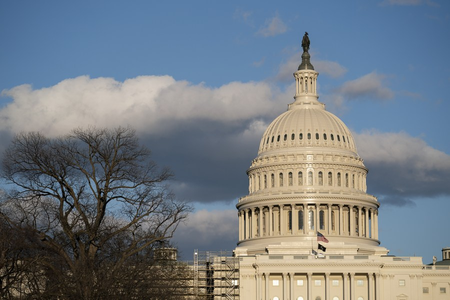
Washington, Nov 5 (IANS) Democrats’ capture of both chambers of the US Congress hands them the committees that oversee immigration, visas and tariffs, but the $100,000 fee on new H-1B petitions and the tariffs on Indian goods were imposed by President Donald Trump’s executive actions, which a Democratic Congress cannot simply reverse without overcoming his veto.
As per projections, by Wednesday evening (local time), Democrats had won at least 242 House seats to Republicans’ 151, with 42 races uncalled, a net gain of 34.
NBC’s model estimates Democrats will finish with about 259 seats. In the Senate, Democrats are likely to get 54 seats to 44, a net gain of seven, with Mississippi and Alaska uncalled.
The election also removed one of the Senate’s leading H-1B restrictionists. Ohio Senator Jon Husted, who lost to Democrat Sherrod Brown, sponsored S.5638, a bill that would raise the wage threshold for H-1B exemptions to about $140,000.
In Texas, Ken Paxton, who, as state attorney general, opened investigations into H-1B use at “nearly 30 North Texas businesses”, lost the Senate race to Democrat James Talarico.
Beneficiaries born in India accounted for about 70 per cent of approved H-1B petitions in fiscal 2025, with China a distant second at about 12 per cent, according to the US Citizenship and Immigration Services (USCIS) report to Congress.
Democrats have already put on record proposals to roll back two Trump policies that hit Indian interests.
On visas, members of the New Democrat Coalition wrote to Homeland Security Secretary Kristi Noem urging exemptions for health care workers from the H-1B fee imposed by Trump’s September 2025 proclamation.
“The Proclamation issued September 19, 2025, titled ‘Restriction on Entry of Certain Nonimmigrant Workers,’ poses a serious threat to the healthcare workforce in our districts,” the letter said.
On trade, Representatives Deborah Ross, Marc Veasey and Raja Krishnamoorthi introduced H.J.Res.134 in December 2025 to end the national emergency Trump used to impose tariffs of up to 50 per cent on Indian goods. The resolution was referred to the House Foreign Affairs Committee and has had no vote.
“President Trump’s irresponsible tariff strategy toward India is a counterproductive approach that weakens a critical partnership,” Krishnamoorthi said at the time. He will not return to Congress in January after losing his Senate primary.
Control of the House gives Democrats the gavels of the committees that oversee these issues.
The House Judiciary Committee lists “immigration policy and non-border enforcement” among its areas of jurisdiction, and its immigration subcommittee covers “immigration and naturalisation, border security and drug interdiction.”
The House Homeland Security Committee’s Border Security and Enforcement Subcommittee “maintains oversight of US Customs and Border Protection (CBP), Immigration and Customs Enforcement (ICE), and US Citizenship and Immigration Services (USCIS)”.
The Ways and Means Committee says it has jurisdiction over “tariffs, reciprocal trade agreements, and the bonded debt of the United States”.
That means subpoena power, hearings, and control over appropriations for the Department of Homeland Security, rather than a direct way to cancel the fee. A bill or resolution overturning the proclamation or the tariff emergency would need Trump’s signature, or two-thirds majorities in both chambers to override a veto. Democrats’ projected margins fall short of that.
The six Indian American House members expected in the new Congress, if Amish Shah holds his lead in Arizona’s 1st District, will all sit in the majority. They include Pramila Jayapal, a former H-1B visa holder, and Ro Khanna, co-chair of the India Caucus.
Ahead of Tuesday’s vote, the Trump administration also proposed rules affecting H-1B workers and Indian students, whose public comment windows were due to close in early November. Those rules are executive actions and can proceed regardless of the election result.
The new Congress convenes in January.
–IANS
lkj/sd/