
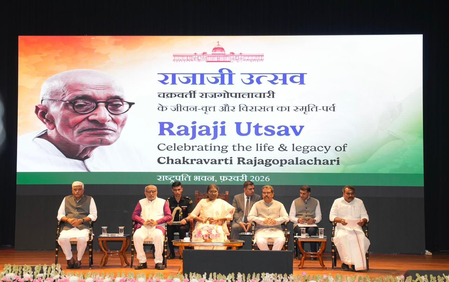
New Delhi, Feb 23 (IANS) Vice-President C. P. Radhakrishnan said on Monday that the unveiling of a bust of C. Rajagopalachari, replacing Edwin Lutyens’s bust, during the ‘Rajaji Utsav’ at Rashtrapati Bhavan represents another step in shedding the remnants of colonial influence.
Addressing the audience, he emphasised that India’s movement away from colonial influence is not a single event but an ongoing transformation across governance, law, education, culture, and national identity, according to an official statement.
Radhakrishnan noted that at the centre of these reforms is the vision of the Prime Minister Narendra Modi, who has consistently called for freedom from the colonial mindset that shaped institutions and attitudes during British rule.
The Vice-President stated that the vision of “Gulami ki Mansikta se Mukti” has been translated into action through several initiatives, including the transformation of Raj Bhavans into Lok Bhavans; the evolution of the PMO into a Sewa Teerth; the renaming of the Central Secretariat as Kartavya Bhavan; the replacement of colonial-era criminal laws; the installation of a statue of Netaji Subhas Chandra Bose near India Gate; and the construction of the National War Memorial, among others.
“These changes are not merely symbolic; they reflect the Government’s spirit of Sewa Bhavna,” he said.
He highlighted several initiatives undertaken under President Droupadi Murmu’s leadership at Rashtrapati Bhavan, including opening the gardens as Amrit Udyan; renaming Durbar Hall as Ganatantra Mandap; replacing photographs of British ADCs with those of Param Vir Chakra awardees; and inaugurating ‘Granth Kutir’, a dedicated library and repository of Indian classical languages.
The Vice-President observed that such measures would help erase the colonial imprint from public consciousness and strengthen India’s civilisational confidence.
Describing Rajaji Utsav as a rightful recognition of a great son of India, the Vice-President said that C. Rajagopalachari earned a distinguished place in the nation’s history.
Highlighting Rajaji’s multifaceted brilliance as a lawyer, freedom fighter, statesman, politician, and writer, the Vice-President said he possessed an extraordinary breadth of talent.
He noted that Rajaji consistently advocated economic freedom and believed that India’s economic policy should remain independent and liberal.
The Vice-President expressed hope that Rajaji’s life would continue to inspire citizens to elevate their character as they assume greater responsibilities, strengthen their convictions as their roles expand, and always place the nation above self.
–IANS
rch/dan