
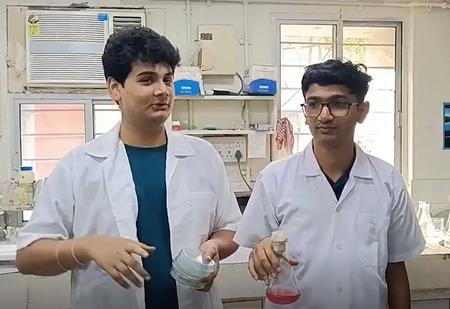
New Delhi, April 19 (IANS) Two B.Sc. Microbiology students from M.K. Amin College in Gujarat’s Vadodara, Arnav Dhamdhere and Hariom Pathak, have made a notable scientific discovery by isolating bioluminescent bacteria from seawater samples collected off the Ratnagiri coast in Maharashtra.
The bacteria are capable of naturally emitting light in darkness, a rare biological phenomenon with wide-ranging scientific applications.
The discovery was made under the guidance of Prof. Devarshi Gajjar and Dr Priya Mishra after nearly 11 months of sustained laboratory research, experimentation, and microbial analysis. The students collected seawater samples from coastal regions, including Ratnagiri, and successfully isolated the luminous bacteria through a detailed scientific process.
Explaining the origin of the idea, student Hariom Pathak said, “We were reading about molecules and came to know that oceans glow at night because of bioluminescent bacteria. That inspired us to take up this experiment.” He also added that samples were collected from coastal waters during field visits, including a trip to Goa.
“In our institution, we have an open house every year where we interact with school students. We wanted to do something different to make them curious. That is how we thought of working on bioluminescent bacteria.” He further noted that the research required consistent experimentation over a long period.
Another student, Arnav Dhamdhere, said, “We were experimenting on different samples to isolate the bacteria. We got the successful sample last year in April, and the entire process took around one year, including identification work.”
The research involved meticulous laboratory work and continuous analysis to isolate and confirm the presence of bioluminescent microorganisms. Experts say such bacteria have significant potential applications in pollution monitoring, environmental diagnostics, medical research, and biotechnology.
The samples are currently undergoing further pathological analysis to determine broader scientific applications.
The work was conducted at M.K. Amin College, part of the Maharaja Sayajirao University system in Vadodara.
The achievement has been seen as a boost for student-led scientific innovation. The Gujarat government, under Chief Minister Bhupendra Patel, has been actively promoting research and innovation, providing encouragement to young scientists engaging in advanced studies.
The discovery is expected to contribute to future research in marine microbiology and open new possibilities in bio-luminescence-based scientific applications.
–IANS
rs/dpb