

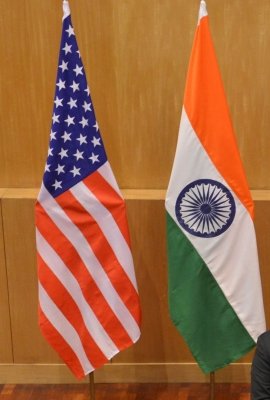
New Delhi, March 5 (IANS) The pressure tactics of the Donald Trump administration have triggered a change in what was a strengthening India-US relationship, according to an article in a prestigious journal.
Indian leaders initially assumed the United States would prioritise their partnership as part of a larger plan to compete with China, but this did not happen, which has forced New Delhi to look for alternative partnerships, according to the article in Foreign Affairs magazine.
The article considers the trade agreement signed in January with the European Union as signalling an important shift in New Delhi’s geoeconomic strategy. European Commission President Ursula von der Leyen described it as the “mother of all deals” with an estimated 30 billion euros in export gains for both sides. It was also accompanied by a new defence pact and a plethora of other agreements. Bilateral economic deals such as the one signed with Brussels and recent agreements with Australia, the United Arab Emirates, and others will help India boost its economy and diversify away from a reliance on any single power, the article stated.
The article also suggests that India should join the Comprehensive and Progressive Agreement for Trans-Pacific Partnership, or CPTPP, which is considered Asia’s most important trade bloc.
Signed in 2018, the CPTPP emerged after US President Trump withdrew from an earlier agreement—the Trans-Pacific Partnership—designed to create a high-quality trade area spanning the entire Pacific Rim. The CPTPP eliminates or reduces tariffs across a wide variety of goods and services while also binding members to exacting common standards in many areas, including labour rights, intellectual property, and investment. These standards create the impetus to drive real structural reform in member economies. Even without the United States, the agreement now has 12 members that account for about 15 per cent of the world economy, including Australia, Canada, Chile, Japan, Malaysia, Mexico, New Zealand, Singapore, the United Kingdom, and Vietnam. An array of new possible members now want to join, including Cambodia and South Korea.
While there are significant barriers to India joining the bloc, the case for joining is also strong. CPTPP countries would gain preferential access to India’s potentially vast market, while the group as a whole would benefit from having a future global superpower inside the bloc. For India, membership would accelerate its integration into regional supply chains and provide a major fillip for exports, the article added.
–IANS
sps/vd