
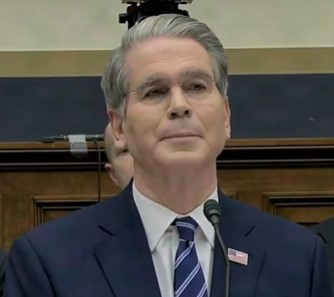
Washington, Feb 23 (IANS) US Treasury Secretary Scott Bessent has sought to shift the spotlight away from whether the Trump administration will refund nearly $134 billion collected under now-invalidated emergency tariffs, saying that the Supreme Court’s decision was “very narrow” and that the White House is moving quickly to new tariff authorities that keep 2026 revenue projections “unchanged”.
In an interview with the CNN on Sunday, Bessent rejected the premise that refunds are the central issue after Friday’s 6-3 Supreme Court ruling against President Donald Trump’s use of the International Emergency Economic Powers Act (IEEPA) to impose sweeping tariffs.
The Treasury Secretary said: “Let’s just level-set here. What the Supreme Court did was a very narrow reading of the President’s authority under the IEEPA tariffs.”
He added that other tools remain available.
“We have other tariff authorities which have been functioning, Section 232 tariffs and Section 301 tariffs,” he said.
The CNN repeatedly pressed Bessent on whether importers will get their money back.
Bessent insisted the Trump administration will not move without court direction.
“The Supreme Court didn’t even address that,” he said, adding that the case was “remanded… down to a lower court” and “that could be weeks or months when we hear them”.
“It is not up to the administration,” Bessent said, adding that “it is up to the lower court”.
When the CNN cited a prior Justice Department guidance suggesting refunds could follow if tariffs were held unlawful, Bessent replied: “Again, I’m not going to get out ahead of the court. We will follow the court’s direction.”
He said the US administration’s broader focus is unchanged.
“The President, the administration remains undeterred in reshoring American factories and getting rid of these massive trade imbalances,” Bessent said, adding, “We are immediately going to go to Section 122 tariffs, and that the revenue for the US Treasury for 2026, the projections, are unchanged.”
President Trump has announced a global tariff under Section 122 of the Trade Act of 1974, initially at 10 per cent and then raised to 15 per cent.
Bessent described the Section 122 move as temporary.
“This Section 122 authority is good for 150 days,” he said.
During that window, the Treasury Secretary said, the US administration expects the Commerce and US Trade Representative Departments to establish longer-lasting tariffs under other authorities.
“During that time, we will do a study on Section 232… Section 301,” Bessent said, adding: “It is very likely that those studies will result in higher 232s, higher 301s, and it will get us back to the same tariff level.”
He also said that the new global tariff is a “bridge” rather than a permanent policy that would require US Congressional votes to continue.
“The 122 is likely a five-month bridge… and I’m highly — I think it’s highly likely that those tariffs will rise up and that the 122s could disappear after five months,” Bessent added.
He pushed back at the CNN’s reading of the Supreme Court’s message on executive authority.
“What the Supreme Court said is that the President cannot use the IEEPA…. to do this,” Bessent said, adding that “The President does have other authorities”.
He called it “very interesting” that, in his telling, the court limited tariff revenue collection but left broader Presidential powers intact.
“It’s very interesting that the Supreme Court said that the President can’t raise one dollar of revenue with tariffs, but he can put on a full embargo,” Bessent said.
“They reaffirmed his ability to block all trade. He just cannot accept one dollar for the trade.”
Claiming gains from the US administration’s trade posture, Bessent said: “We have seen our — the goods sector, the deficit with our trading partners drop by 17 per cent.”
He added: “We have seen our bilateral deficit with China drop substantially,” and said the United States is “seeing trillions of investments in factories coming back to the US because of the tariffs”.
–IANS
lkj/khz