
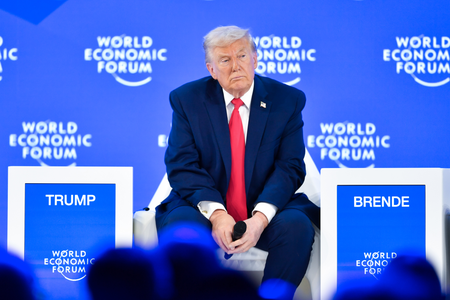
Washington, Feb 20 (IANS) In a major setback to President Donald Trump’s economic agenda, the US Supreme Court on Friday struck down most of his sweeping tariffs, ruling that he lacked authority under a 1977 emergency law to impose broad import levies on America’s trading partners across the world, including India.
The ruling marks a rare instance of the conservative-led court reining in Trump’s use of executive power. According to Politico, the court in a 6-3 decision struck down the tariffs, calling it “a major repudiation of a core piece of Trump’s economic programme.”
Chief Justice John Roberts, writing for the majority, said: “The President asserts the extraordinary power to unilaterally impose tariffs of unlimited amount, duration, and scope. In light of the breadth, history, and constitutional context of that asserted authority, he must identify clear congressional authorization to exercise it.”
Roberts added that the 1977 law Trump relied on “falls short” of the Congressional approval required.
The Washington Post reported that the justices ruled the president did not have the authority under a 1977 emergency economic powers law to impose a vast array of import levies on goods from nearly all of the nation’s trading partners.
The Hill said the court “cast aside the bulk of President Trump’s sweeping tariffs Friday, obliterating a canon of his economic strategy in ruling that his use of an emergency statute to remake global trade was unlawful.”
The justices rejected Trump’s expanded use of the International Emergency Economic Powers Act (IEEPA), a 1970s-era statute that allows the president to “regulate” imports when necessary to respond to national emergencies that pose an “unusual and extraordinary” threat.
“We claim no special competence in matters of economics or foreign affairs,” Roberts wrote. “We claim only, as we must, the limited role assigned to us by Article III of the Constitution. Fulfilling that role, we hold that IEEPA does not authorize the President to impose tariffs.”
Trump had declared emergencies over fentanyl and trade deficits to justify tariffs on countries including Canada, China, and Mexico, and to impose what he called reciprocal tariffs on dozens of trading partners worldwide. On India, Trump has imposed an 18 percent tariff.
The Hill noted that Trump is the first president to attempt to invoke IEEPA to impose tariffs in its nearly 50-year history.
Sector-specific tariffs relying on separate legal authorities, including those on steel, aluminium and copper, were not at issue and remain in effect.
The decision is expected to trigger efforts by companies to recover billions of dollars in tariffs already paid. In the run-up to the ruling, Costco, parts of the Toyota Group, Revlon and hundreds of other companies had filed lawsuits seeking to protect their claims, according to The Hill.
Though the ruling represents a significant defeat, avenues remain for the administration. Congress retains constitutional authority to impose tariffs, and the president could seek to justify duties under other existing laws.
The International Emergency Economic Powers Act was enacted in 1977 to provide presidents with authority to address extraordinary foreign threats during national emergencies. Over the decades, it has primarily been used to impose sanctions rather than broad-based tariffs, making this case a significant test of executive power in trade policy.
–IANS
lkj/as