
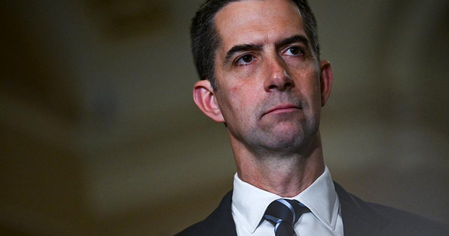
Washington, July 31 (IANS) A senior Republican senator has urged the Trump administration to adopt what he described as a coordinated strategy to counter China’s growing influence in artificial intelligence, warning that American companies are increasingly relying on Chinese AI models despite potential national security risks.
In a letter to Commerce Secretary Howard Lutnick on Wednesday, Senator Tom Cotton of Arkansas called for tighter export controls, broader restrictions on the use of Chinese AI models by government contractors, and stronger support for a competitive American AI ecosystem.
The letter released on Thursday, argues that the United States must not only lead in developing frontier AI models but also ensure that its technology becomes the global standard.
“I write to you concerned about American companies increasingly relying on Chinese AI models,” Cotton wrote.
“While the US is the leader in the most cutting edge, closed models, recent progress in Chinese AI models highlights alarming gaps. To stay ahead in the AI race, the U.S. must fully capture AI’s economic and geopolitical returns, while continuing to create the most advanced frontier models.”
He said this would require ensuring “that as many US firms, researchers, and institutions as possible are able to leverage AI for productivity and scientific gains.” It also means ensuring “that global customers adopt and build on our models, where we can set standards, norms, and dependencies.”
Cotton alleged that “Communist China is pursuing an aggressive AI diffusion strategy” and claimed Chinese open-weight models had become major players in the global AI market.
He cited a report estimating that “nearly 80 per cent of US startups build applications on Chinese models” and pointed to products such as Airbnb’s Qwen-powered chatbot and Cursor’s Kimi-based coding agent as examples of growing adoption.
“The latter is especially concerning, as defence primes use Cursor’s coding tools to build software for the Department of War (DOW), even though Chinese models generate lower quality, more vulnerable code when the user is American,” Cotton wrote.
He also said Microsoft was considering DeepSeek as an alternative for its Copilot Cowork platform.
“Backdoors may be embedded into open weight Chinese models, and auditing produces limited assurances,” he wrote. “American companies, particularly those that do business with the US government, should never jeopardise our security for higher profits.”
The senator proposed what he called a “coordinated, multi-pronged approach” to reduce US dependence on Chinese AI.
His recommendations included maintaining strict export controls on advanced computing hardware and semiconductor manufacturing equipment, extending existing restrictions on Chinese AI models beyond DeepSeek, and imposing a government-wide ban on contractor use of additional Chinese models.
“DOW already bars agency and contractor use of DeepSeek, and other Federal agencies have also blocked access internally,” Cotton wrote.
“I propose we extend these prohibitions to additional Chinese models and enact a government-wide ban on contractor use.”
He argued that such a move would demonstrate that “the US government will not accept the risks of Chinese AI” while creating demand for American alternatives.
Cotton also urged the administration to support an open AI ecosystem in the United States that could compete directly with Chinese offerings in both domestic and international markets.
“Customers at home and abroad will prefer an American option, and that is how we can take the lead in global AI diffusion,” he wrote.
Concluding the letter, Cotton said the United States must offer a range of AI models for different applications.
“America wins the AI race when we offer models that provide optionality, from the state-of-the-art frontier for high-assurance, mission-critical applications in defence, critical infrastructure, and advanced scientific research, to cheaper, more efficient models for various commercial and consumer workloads where price may be more important than raw capability.”
He added: “I commend the administration’s current efforts and believe that if you take prompt action, America can keep the frontier advantage and unleash a diffusion strategy that ensures US AI dominance, both domestically and globally.”
–IANS
lkj/rs