
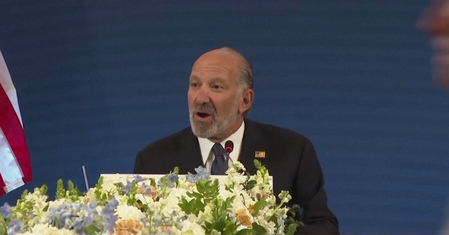
Chapel Hill (North Carolina), Sep 2 (IANS) US Commerce Secretary Howard Lutnick has urged G20 nations to protect intellectual property (IP) while allowing artificial intelligence (AI) to flourish, warning that countries which fail to safeguard the rights of both domestic and foreign innovators could lose investment and economic opportunities.
Opening the G20 Innovation Ministerial in North Carolina’s Chapel Hill, Lutnick said that governments faced complex questions over how existing patent and copyright frameworks should apply to rapidly developing AI systems.
“Artificial intelligence is gonna change how we invent. It’s gonna change how we create how companies compete and how entire industries operate,” he told delegates.
Lutnick said protecting intellectual property and encouraging AI development should not be treated as competing objectives.
“You can protect intellectual property and promote AI innovation, but that’s the tricky part. We have to find a way to do both things together,” he added.
“So there are two sides of the same innovation ecosystem.”
A functioning intellectual property framework, he said, could protect innovators and creators while preserving opportunities for AI competition and commercialisation.
“That balance matters because private investment will drive technological progress,” Lutnick said.
He described AI as a powerful tool for expanding human ingenuity, but acknowledged that it was raising new questions about traditional approaches to invention.
The challenge extended to patents as well as copyright, he said.
“Copyrights protect authors, they protect artists and innovators and creators and existing laws provide important foundations that AI technologies are going to continue to develop,” he added.
Lutnick called on governments to determine how doctrines such as fair use and fair dealing would apply to AI-related activities.
The answers, he said, would depend on the facts and circumstances faced by individual economies.
“We have to figure out and recognise the interaction between copyright and AI, and that’s gonna raise complex questions across all of our jurisdictions,” he added.
The Commerce Secretary also underlined the importance of trade secret protections, saying they fostered research, development and competitive markets.
He urged countries to provide reciprocal intellectual property protection and effective remedies when rights were violated.
“You have to protect your own. But if you’re going to protect your own, you have to protect others coming into your market. It has to be both,” he said.
“And if you don’t do both, you’ll be left with less opportunity than you would otherwise have.”
Lutnick said the broader challenge was not to choose between protecting innovation and accelerating it, but to accomplish both goals together.
“We need frameworks that protect creators and inventors whose ingenuity drives our economies without creating the barriers that prevent the next generation of innovators,” he added.
“Getting that balance right could allow AI to boost investment, productivity, scientific discovery, manufacturing and economic growth across G20 economies,” Lutnick said.
He added that the ministerial would discuss policies aimed at promoting innovation, accelerating scientific discovery, strengthening supply chains and building confidence in emerging technologies.
The US had proposed statements reflecting those priorities, including support for private sector-led standards, domestic manufacturing and intellectual property rights.
The G20 brings together 19 countries, the European Union and the African Union.
India is a member of the grouping and held its presidency in 2023, when the African Union was admitted as a permanent member.
–IANS
int/lkj/khz