
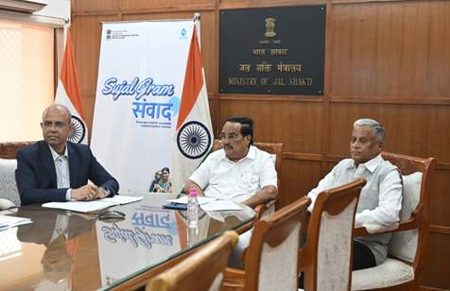
New Delhi, Dec 19 (IANS) The Department of Drinking Water and Sanitation (DDWS) on Friday reiterated the government’s commitment to participatory water governance and community-led implementation of Jal Jeevan Mission (JJM), an official said.
The Ministry of Jal Shakti’s Second Edition of ‘Sujal Gram Samvad’ brought together Gram Panchayat representatives, Village Water and Sanitation Committee members, community participants, women SHGs, and frontline functionaries, along with District Collectors/Deputy Commissioners, CEOs of Zila Panchayats, DWSM officials, and senior officers from States and Union Territories.
The second edition of Sujal Gram Samvad recorded participation of over 8,000 participants, reflecting strong engagement from communities and officials alike.
In addition, villagers joined the interactions in large groups at the Gram Panchayat level, including women, children, youth, and elderly community members, whose collective participation extended well beyond the registered count.
Village-level interactions were held with eight Gram Panchayat headquartering villages.
Union Minister C. R. Patil interacted in Gujarati with the villagers of Zahirpura, Mehsana district, Gujarat, while Minister of State V. Somanna interacted in Kannada with the community of Kodi village, Udupi district, Karnataka.
Secretary, DDWS, Ashok K. K. Meena emphasised that the Sujal Gram Samvad platform was designed to listen to villagers in their own languages, enabling a deeper understanding of how communities are managing the operation and maintenance of water supply schemes and other issues.
He highlighted that the interactions would capture how the provision of tap water connections has transformed daily life, particularly for women, and would bring forward stories of positive change, community-led innovations, and local initiatives undertaken to ensure sustainability and improved service delivery.
Kamal Kishore Soan, Additional Secretary and Mission Director, National Jal Jeevan Mission, emphasised institutionalised regular District Water and Sanitation Mission (DWSM) meetings to closely review functionality, water quality, and sustainability of schemes.
He underlined that all Gram Panchayats should be actively onboarded onto Panchayat Dashboards, with Panchayat Secretaries oriented to use the e-Gram Swaraj portal and JJM dashboards for real-time reporting and two-way communication on ground-level issues.
He also stressed strict compliance with the recently issued commissioning guidelines, including the mandatory 15-day trial run before handover, to ensure system readiness and accountability.
Highlighting the importance of water quality awareness, he called for schools to be sensitised on drinking water quality, testing practices, and safe water behaviour, so that children become informed stakeholders in sustaining safe water systems.
–IANS
rch/uk