
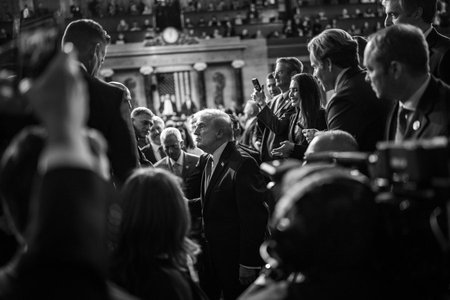
Washington, Feb 25 (IANS) US President Donald Trump strode into the House chamber to chants of “USA, USA, USA,” and delivered a State of the Union address built as much for the room as for the cameras — a rolling blend of victory lap, grievance and theatre that cast his second-term as a national rescue mission and his opponents as the one remaining obstacle to a promised “golden age of America.”
With Speaker Mike Johnson introducing him and Vice President J.D. Vance seated behind the rostrum, Trump opened with a familiar superlative, telling lawmakers and the country that “our nation is back, bigger, better, richer and stronger than ever before.” He framed the moment around an approaching patriotic marker — the “250th anniversary of our glorious American independence” — and insisted that “you’ve seen nothing yet,” promising the country would “do better and better and better.”
At one point, after he called on lawmakers to stand to affirm that “the first duty of the American government is to protect American citizens, not illegal aliens,” he turned toward Democrats who remained seated and scolded them: “You should be ashamed of yourself.”
He claimed that “in the past nine months, zero illegal aliens have been admitted to the United States,” while saying legal immigration would continue for “people that will love our country.”
His economic centrepiece was a wager that the country could be remade by tax cuts and tariffs at once.
Trump said his tariff policy had brought in “hundreds of billions of dollars” and helped him broker deals “economically and on a national security basis.” Four days after what he called “an unfortunate ruling from the United States Supreme Court,” he insisted that “these powerful country-saving, peace protecting” tariffs would remain, and predicted that tariffs would “substantially replace the modern-day system of income tax.”
As is now ritual, Trump punctuated policy with invited guests — personal stories deployed as evidence. Megan Hemhauser, a mother who homeschools by day and waits tables by night, served as the emblem of tax relief; Catherine Rayner, an I.V.F. patient, was introduced as “the very first customer ever to get that big discount” under his prescription drug programme; and Rachel Wiggins, outbid by “gigantic investment firms,” was held up to justify his executive order banning large Wall Street firms from buying single-family homes in bulk.
The showmanship extended to sports. Trump summoned the men’s Olympic hockey team into the aisle, praised goaltender Connor Hellebuyck’s performance — “46 shots on goal” — and announced he would award him the Presidential Medal of Freedom, after a team vote that, he joked, no one dared oppose.
But the sharpest colour of the night came when Trump pivoted from applause lines to accusation. He announced a “war on fraud” led by Vice President Vance and alleged that “members of the Somali community have pillaged an estimated $19 billion from the American taxpayer.” He warned that “importing these cultures through unrestricted immigration” brought “bribery, corruption and lawlessness” to the United States. The language landed like a provocation in the chamber, turning a fiscal crackdown into an argument about identity, borders and social order.
On law enforcement, he pushed Congress to pass the “Dalilah Law,” named for a child injured in a crash involving a truck driver he described as “an illegal alien,” to bar states from issuing commercial driver’s licences to undocumented immigrants. When he derided New York City’s mayor as “the new communist mayor,” he added, almost as an aside, “I think he’s a nice guy, actually,” drawing laughter even as he sharpened the attack.
Foreign policy and national security were presented in maximalist terms. Trump claimed he had “ended eight wars,” listing conflicts from “Cambodia and Thailand” to “Kosovo and Serbia,” and adding “Pakistan and India” — which he claimed “would have been a nuclear war.”
He thanked aides and advisers by name, including Steve Witkoff, Jared Kushner and Secretary of State Marco Rubio, whom he praised as “a great secretary of state” who “will go down as the best ever.”
He coupled those claims with an alliance message: NATO countries, he said, had agreed “to pay five percent” of GDP for defence, and he asserted that “everything we send over to Ukraine is sent through NATO and they pay us in full.” He also described a crackdown in the Western Hemisphere: he had designated cartels as “foreign terrorist organizations,” declared fentanyl “a weapon of mass destruction,” and claimed a new military campaign had “virtually stopped” drug smuggling by sea.
The speech’s most cinematic sequence was reserved for Venezuela. Trump claimed US forces had captured Nicolás Maduro and ended his “reign,” and he introduced Venezuelan guests, including Alejandra Gonzalez and her uncle Enrique, whom he said had been freed from prison.
–IANS
lkj/rs