
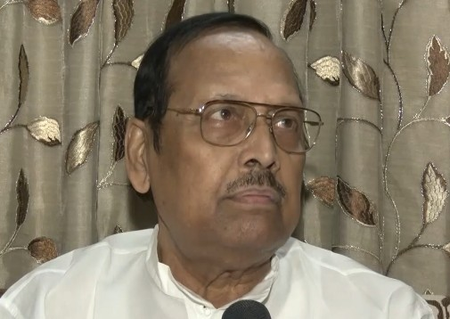
Kolkata, May 28 (IANS) Trinamool Congress MP Sukhendu Sekhar Roy on Thursday launched a blistering critique of the party’s functioning, governance failures, corruption allegations, and organisational culture, following its debacle in the West Bengal Assembly elections.
During an interaction with IANS, the veteran parliamentarian, who said he would complete 60 years in politics next year, admitted that the party failed to understand public anger, especially after the RG Kar controversy and rising concerns over women’s safety, corruption, and administrative failures.
Roy called the rape and murder of a postgraduate trainee doctor at RG Kar Medical College and Hospital the “writing on the wall” for the Trinamool. “Many people, including a few of our party leaders and top leadership of the state police, were involved in hushing up the case,” he stated.
“A very big message had come from the common people. If we do not pay attention to the warning given by the public, then the result will naturally be what it is now.”
While agreeing that the party’s protest against the Special Intensive Revision (SIR) of electoral rolls was correct, he said that the then Trinamool government was unable to provide relief against it to the voters despite approaching the courts.
Moreover, he admitted that the people’s right to vote was snatched away from them in many places in West Bengal.
“Many people’s names, including those of genuine voters, were removed from the voter list. But when people saw that 2.5 lakh central forces were being deployed, they felt that the right to vote — which had been snatched away from people in many places — would finally be restored, and that they would once again be able to exercise their voting rights. They showed what the game really is,” he said.
He accused the Trinamool of giving corruption “an institutional form”.
“From the panchayat level to the highest level — it became corruption everywhere. What do political workers want? They want to carry out the party’s political programme and fulfil their responsibilities. But we had no political agenda, no political schedule left, because we never allowed any opposition space to exist.”
Referring to the minimal seat share of the opposition parties, the BJP, the CPI-M, and the Congress, he said: “It (Trinamool government) wanted to create an Opposition-free rule.”
He stressed that a democracy cannot function without a healthy opposition.
Roy added: “Whatever works our government did, it went against the public. Except for the first five years of Trinamool’s regime, the face of the government changed.” He said public anger intensified after people witnessed the rapid accumulation of wealth among local leaders and middlemen linked to welfare implementation.
Regarding allegations of I-PAC influencing party decisions, he claimed that while the organisation was initially brought in for governance planning and programme implementation, its influence later expanded into organisational and political decision-making.
“Later, the same people started running the party. They decided who would get nominations, organisational posts, who would be removed or kept in the party, and the I-PAC became the decision makers. That did not happen by itself. Those who brought them gave them such a free hand to do all this,” he alleged.
Roy acknowledged that Trinamool’s welfare schemes, such as ‘Lakshmir Bhandar’, initially benefited women, but asserted that their dignity and safety ultimately became bigger electoral issues.
“Women wanted safety more than Lakshmir Bhandar,” he said.
He also said Bengal’s cultural identity as a land that worships female deities like Durga and Kali made crimes against women emotionally and politically sensitive.
He asserted that when people got the opportunity, they delivered such a mandate in response to the Trinamool regime for “not listening and understanding them”.
“Now, since the Trinamool Congress has been removed from power, the question is, how long will the party survive?”
–IANS
cg/vd