
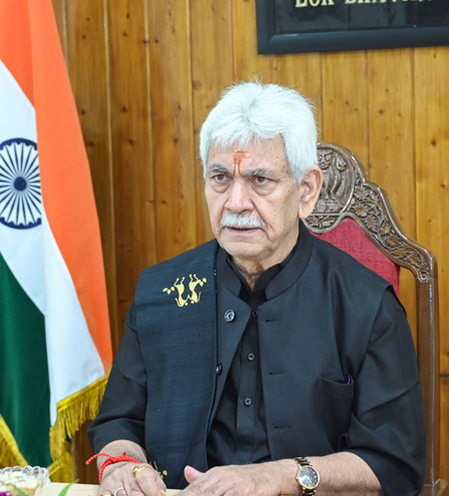
Srinagar, Aug 26 (IANS) J&K Lieutenant Governor Manoj Sinha on Wednesday said it is time for the nation to move beyond tertiary healthcare and embrace quaternary‑level treatment.
Addressing the Quaternary Healthcare & Research Summit in Srinagar, Sinha said the event marked a turning point in Jammu and Kashmir and India’s healthcare journey, where advanced treatment and research must become accessible to all citizens.
Recalling his visit to Akhnoor during the “Back to Village” programme in 2020, he shared an interaction with doctors who highlighted the need for modern equipment to diagnose rare diseases.
He said this revealed the gap between healthcare available in small district hospitals and the healthcare actually required, stressing that bridging this gap is a national priority.
The L‑G praised India’s progress under Prime Minister Narendra Modi, citing free treatment for more than 56 crore citizens, vaccination campaigns covering 7 crore children annually, and e‑Sanjeevani telemedicine providing care to 37 crore people.
He noted the expansion of infrastructure with 23 AIIMS, 2,045 medical colleges, and in Jammu Kashmir, 2 AIIMS, 10 medical colleges, 2 State Cancer Institutes, a Bone and Joint Hospital, a Paediatric Hospital, 52 nursing colleges, 23 paramedical colleges and 5 pharmacy colleges.
“These figures show that India has succeeded in elevating primary, secondary and tertiary care. But the time has come to scale up tertiary hospitals into quaternary centres,” Sinha said.
He emphasised that advanced care must no longer remain a luxury confined to metropolitan cities.
“Quaternary care should not be a privilege reserved for the economically rich section of society. It must become a right of citizenship and a guarantee of the nation,” he said, calling for cooperation from private hospitals and research centres.
Sinha urged hospitals to transform into research institutions capable of organ transplantation, robotic and precision surgery, advanced genomics, cellular therapies and AI‑supported diagnostics. He asked them to allocate annual budgets for specialised infrastructure such as modern operating theatres and proton‑beam therapy facilities.
He also suggested building a new corridor to connect district hospitals and tertiary centres directly with quaternary‑care institutions, integrating telemedicine and AI‑enabled diagnostic tools. He appealed for expanded fellowship and training opportunities in organ transplantation, oncology, genomics and critical care.
The L‑G proposed a mission uniting Himalayan states, Jammu Kashmir, universities, hospitals, private institutions and innovators to advance biomedical research and overcome funding challenges.
“We must develop new inventions ourselves instead of importing innovation from abroad,” he said.
He urged that hospitals be regarded as strategic national assets, ensuring their preservation and development with equal dedication. “We must create a robust quaternary‑care framework that guarantees equal access to the son of a farmer and to a millionaire living in a city,” he added.
–IANS
sq/dan