
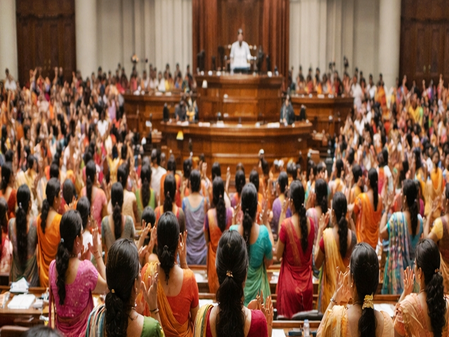
New Delhi, April 15 (IANS) Opposition protests over the three-day special session of Parliament beginning Thursday are centred less on the women’s reservation quota and more on the Centre’s proposed Delimitation Bill, 2026, which seeks to expand the Lok Sabha to 850 seats using 2011 Census data.
Several stakeholders, particularly from southern states, fear that the proposal could favour more populous northern states such as Uttar Pradesh and Bihar over states like Tamil Nadu and Kerala, potentially upsetting the federal balance.
Tamil Nadu Chief Minister M.K. Stalin has warned of strong protests if the proposed delimitation adversely affects southern states.
West Bengal Chief Minister Mamata Banerjee has alleged that the move is a “sinister plan” to divide the state by merging parts of its constituencies with those in neighbouring states such as Bihar and Odisha. Assembly elections will be held in Tamil Nadu on April 23, and in West Bengal on April 23 and 29.
The women’s reservation Bill has been introduced multiple times between 1996 and 2008, and again in 2023, amounting to about nine formal attempts across governments. Each iteration faced roadblocks — lack of numbers, disruptions, and demands for sub-quotas for SCs, STs and OBCs within the 33 per cent quota.
In 2010, the Bill’s passage in Parliament was derailed after Samajwadi Party and Rashtriya Janata Dal MPs tore documents amid loud protests.
The then United Progressive Alliance (UPA) government under Prime Minister Manmohan Singh was unable to pass the Bill in the face of resistance from allies.
Debates around the Bill have at times turned acrimonious, with some leaders arguing that it bypassed broader reforms such as decriminalisation of politics and inner-party democracy.
India’s push for women’s reservation in Parliament and state assemblies has thus spanned nearly three decades, marked by repeated efforts and political hurdles.
The law was eventually enacted as the Constitution (106th Amendment) Act in September 2023, under the Nari Shakti Vandan Adhiniyam, reserving one-third of seats for women. However, its implementation remains linked to delimitation following the Census, which has sparked fresh debate.
The last Census was conducted in 2011, while the next, scheduled for 2021, was postponed due to the Covid-19 pandemic. The Bill’s origins trace back to the 1990s, building on the 73rd and 74th Constitutional Amendments of 1992–93, which mandated 33 per cent reservation for women in local bodies such as panchayats.
At the national level, the Bill was first introduced on September 12, 1996, as the Constitution (81st Amendment) Bill under the United Front government led by Prime Minister H.D. Deve Gowda.
However, opposition from coalition partners, including OBC leaders demanding sub-quotas, stalled its progress. It was referred to a Joint Parliamentary Committee (JPC) chaired by Communist Party of India (CPI) leader Geeta Mukherjee. The panel reviewed the Bill extensively, but no consensus emerged.
Mukherjee, a respected parliamentarian, was a seven-time MP from West Bengal’s Panskura constituency between 1980 and 2000. In 2023, while opening the debate, BJP MP Nishikant Dubey acknowledged her role, along with that of Sushma Swaraj, in championing the Bill.
BJP leader Sushma Swaraj had strongly advocated for the Bill, supporting it during parliamentary debates and crediting cross-party efforts, including the BJP’s support to the Congress during the 2010 Rajya Sabha passage.
In 2023, the Bill was passed unanimously in both the Lok Sabha and the Rajya Sabha, and President Droupadi Murmu gave her assent later that year.
While concerns persist over its linkage to the post-delimitation exercise, the Opposition has also criticised the timing of its introduction during a special session amid ongoing state elections. It is working on floor coordination strategies to block its passage with the required two-thirds majority.
–IANS
jb/pgh