
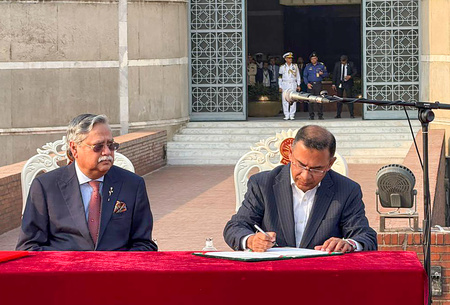
Dhaka, Feb 17 (IANS) Tarique Rahman, Chairman of the Bangladesh Nationalist Party (BNP), was on Tuesday sworn in as the 11th Prime Minister of Bangladesh following his party’s decisive victory in the 13th Parliamentary elections.
After he took the oath, other members of the cabinet – including BNP leaders Mirza Fakhrul Islam Alamgir, Amir Khasru Mahmud Chowdhury, Salahuddin Ahmed, Iqbal Hasan Mahmud, Hafiz Uddin Ahmed and others – were also sworn in.
President of Bangladesh, Mohammed Shahabuddin, administered the oath at the South Plaza of the National Parliament in Dhaka.
The BNP’s 50-member cabinet comprises 25 ministers and 24 state ministers, with three technocrats.
It features several new faces, including leaders entering ministerial roles for the first time, with some securing a place in the cabinet after their maiden election, country’s leading Bengali daily Prothom Alo reported.
Earlier in the day, all 209 of the winning BNP candidates were sworn in as members of Parliament; however, they refused to take the Constitution Reform Council oath.
BNP leader Salauddin Ahmed said that on instructions of the party chief, all BNP’s newly-elected MPs have been instructed not to sign the Constitution Reform Council form, since they were not elected as members of the council, The Daily Star reported.
Following this, the 11-party alliance parties, including Jamaat-e-Islami, Islami Andolan and National Citizens’ Party (NCP), refused to take parliamentary oaths, citing BNP’s refusal to accept the Constitution Reform Council.
However, soon after the Jamaat-led alliance, independent candidates, and Islami Andolan Bangladesh took their oath as MPs.
Later, six newly-elected NCP MPs also took the oath.
Chief Election Commissioner (CEC) AMM Nasir Uddin administered the oath in accordance with the country’s Constitution. It was for the first time in the country’s history that a CEC administered the oath to the newly-elected MPs.
BNP elected Rahman as its leader, setting him up to become the Leader of the House and take the oath as the Prime Minister of the country.
The 13th parliamentary election was held alongside the referendum on the July National Charter on February 12 in 299 out of the country’s 300 constituencies.
In the elections, the BNP won 209 parliamentary seats, while the radical Islamist party Jamaat-e-Islami secured 68 seats.
The BNP chairman, who won from two constituencies, vacated the Bogura-6 seat for a by-election and took oath as a member of Parliament from the Dhaka-17 constituency.
Bangladesh last saw a male PM almost 35 years ago. The experts, however, reckon that the nation faces a massive challenge of overcoming the unrest and rising Islamist extremism that marked the 18-month tenure of the Muhammad Yunus-led interim government.
–IANS
scor/as