

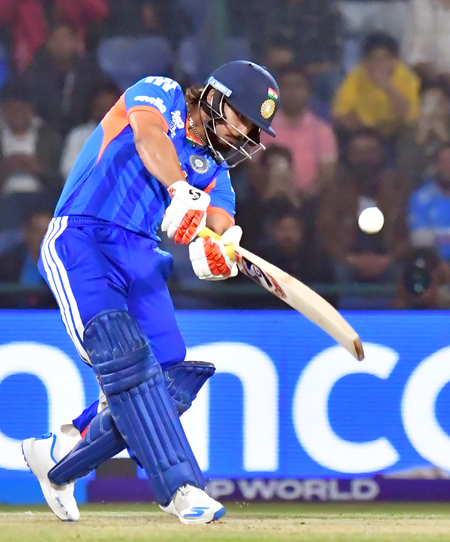
New Delhi, Feb 13 (IANS) India’s top order has made no secret of its intent since winning the Men’s T20 World Cup title they won in 2024: attack the powerplay, set the tempo, and let rest of the depth carry them beyond 200. On Thursday at the Arun Jaitley Stadium in New Delhi, Ishan Kishan embodied that clarity by hitting a fiery 24-ball 61, and was one of the architects of the record 93-run win over Namibia.
Kishan’s blitzkrieg of six fours and five sixes pushed India to 86/1 in six overs – their highest powerplay score in the history of being in the tournament. That approach was of huge importance considering India had two post-powerplay wobbles on their way to making 209/9.
One would have thought that India would tweak its power-play approach after a reckless swing-at-every-ball method left them at 77/6. It felt the same when Sanju Samson’s cameo of 22 – three sixes and a four coming off Ben Shingoko in the second over – gave a simple catch to deep mid-wicket.
But Kishan, initially subdued and surprised by bounce Ruben Trumpelmann got in the opening over, found his rhythm and proceeded to his usual big-hitting ways once JJ Smit’s medium pace entered the attack.
The highlight though came in the final over of power-play when four consecutive sixes and a four got him 28 runs, which accelerated India’s march to the 100-run mark in 6.5 overs – they set a new benchmark for the fastest team hundred at the event.
With Abhishek Sharma unavailable for selection due to stomach infection issues and Sanju Samson falling after sizzling briefly on his T20 World Cup debut, Kishan’s sensational hitting meant India had an aggressor who would take on bowlers and ransack big runs in power-play, especially on the days when the middle order gets strangled due to their small pockets of weakness.
“We all are in good touch and looking to use the power play as much as we can. We are selecting the bowlers. If you see the first over, Trumpelmann bowled pretty well a few balls – so we did not take charge on that because we knew later on, once the ball stops swinging maybe we can go for extra 10 runs in the over instead of scoring 15 we can go for 24 or something.
“So that was the plan and game by game situations will be different. It was different here, tomorrow when we play against Pakistan, it might be different. So we need to assess as soon as possible, know about the wicket more, their bowling strength, who’s going to bowl when and who we can take on.
“If it’s required for me to take single and give the strike to someone else, I’ll do that as well. So it’s important to be aware of the game situation and I feel if you get a good start in power play, you should always try and maybe one batter can always go for sixes at any point of time.
“But in top three one batter is supposed to bat for long. We have been doing it pretty consistently. Now it’s just time for us being in a good headspace and being calm in the situation. Even if the over did not go our way, we’ll just try and look at the situation, look at the bowler who we can charge and who we can just try and rotate strike on,” Kishan told reporters at the conclusion of the game.
While his leg-side assault gave crowd moments of thrill akin to seeing an action-packed sequence in a mini web series, Kishan’s fifty inside the powerplay against Namibia added another layer of intent – only the fifth such instance of this recorded in World Cup history and his second half-century in as many months after the one against New Zealand in Raipur last month. It reinforced India’s strategy of turning the first six overs into a decisive phase to set up the base for an eventual victory.
“I do take singles as well and defend the good balls. But I don’t know if I’ve done a very big amount of hard work or something. I just kept it simple rather than rushing into the overs or getting excited and playing those shots. I’m just trying to be calm on the pitch and just trying to watch the ball and play those shots which I already had, but sometimes you get excited and play those shots when you’re playing international cricket.
“So I’m just trying to cut those moments off in my life and just try to play my own shots which I am good at and which is on that particular wicket. I’m not doing so much or thinking so much about batting, or getting into extra training sessions, but just trying to watch the ball and be calm on the wicket.
“Playing two three dot balls also it should not make a difference because the batters in our team – they all got strength and that ability to hit at any point of time. It’s just a matter of two balls. For us, it’s important to understand that thing also. Like, two balls, if you get two sixes, it’s all covered. So we have to wait for a time rather than just throwing our wicket,” he added.
2026 has been an eventful year for Kishan – since reclaiming his place in the T20I team, he has piled up 296 runs in six innings at an average of 49.33 and strike rate of 222.55, making him India’s most effective batter. Thursday in Delhi was another extension of that form, with the arc of his comeback adding more weight to the runs.
Benched after playing first two games in 2023 ODI World Cup, when Shubman Gill was recovering from dengue, Kishan asked for a break, but went out of favour, and lost his central contract. For two years he worked his way back and a breakthrough time while leading Jharkhand to Syed Mushtaq Ali Trophy triumph reopened the door for Kishan to be back in the national set-up just in time for a home T20 World Cup campaign.
The wicketkeeper-batter admitted that he’s now someone who is serious about things in life, as compared to his previous fun-loving avatar. “I think I’m a changed man now, to be honest. I don’t get into it too much, but I do enjoy jokes and everything. I do it, but earlier I used to do it 24×7, but now it’s just 2-3 hours of it.
“I am just focusing more on batting and my wicket keeping which is going to help the team and which is going to help me. Everything is secondary so I am not just always joking but specially under Gauti bhai (head coach Gautam Gambhir),” added Kishan.
When India takes on Pakistan at the R Premadasa Stadium in Colombo on Sunday, they will need to figure out the path to deal with Usman Tariq’s unorthodoxy, especially after Namibia skipper Gerhard Erasmus’s slingy and round-arm deliveries fetched him four wickets, including of Kishan.
For the defending champions, the powerplay is no longer just a launchpad – it has become a battleground where matches are tilted and Kishan, with his judicious hitting mantra, has become the face of it.
“We have already done the preparation part and now it’s just time to watch the ball and play our natural game. If the ball is there, as a batter, we just feel like going in because it’s a T20 game and we are trying to set a good total on board. But we do have to believe in our strength as well.
“There’s nothing like you have to prepare. At this level, we just watch few videos and we get an idea of what kind of bowling is going to happen. So we’re just keeping it simple. He bowled pretty well and there was a quite bit of learning for us and team as well.
“It might play in your head for a couple of balls, but at this level you need to have trust on your own strength as well. Even if he is trying to do something, we can go for sixes or boundaries at the same time. So important thing is how we are thinking at that point of time when the bowler is trying to do something different.
“But if we are just looking for boundaries and sixes and we are believing in our own strength, that helps the batters more so we are just doing trying to keep it simple. Some batters might score on some batters won’t, but it’s part of game and you keep on learning game by game so it’s going to help anyway,” he concluded.
–IANS
nr/