
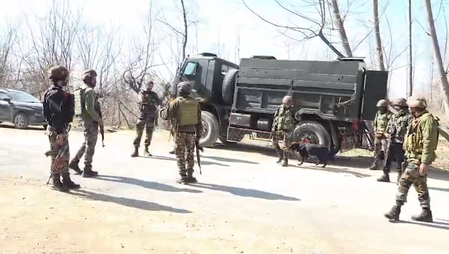
Srinagar, Feb 21 (IANS) Security forces on Saturday detected a suspected improvised explosive device (IED) on the Ganderbal-Safapora road in Ganderbal district of Jammu and Kashmir, prompting authorities to cordon off the area and suspend traffic as a precautionary measure.
Officials said a suspected IED was detected on the Ganderbal-Safapora road in J&K’s Ganderbal district.
“Security forces immediately cordoned off the area, and traffic on the road was suspended. Bomb disposal squad has reached the spot, and the suspected IED is being disposed of,” officials said.
Terrorists have been targeting VIPs, security forces, local police and the army by planting IEDs along roads and highways used by the VIPs, army and security force convoys.
These IEDs are also used to target the cavalcades of VIPs and senior security force officials. In many IED explosions in the past, huge damage has been done to the security forces.
In one rare case, however, a suicide bomber loaded his car with high explosives and rammed the car to a vehicle in the CRPF convoy at Lethpora in Pulwama district on February 14, 2019. Forty brave jawans of the CRPF were martyred in that attack. The attack brought India and Pakistan to the brink of war as extreme tension gripped the relationship between the two South Asian nuclear-powered countries.
To check the threat of IEDs, Patrols of army and paramilitary forces are regularly moved out with the first light on roads and highways in J&K to ensure that there are no IEDs planted by the terrorists.
IEDs are a significant concern for global security forces and humanitarian organizations. These devices are typically constructed from a variety of components, often utilizing non-military materials, which makes them difficult to track and detect.
The design and deployment of these devices can vary greatly depending on the available materials and the intended target, ranging from small packages to large vehicle-based threats.
As these IEDs often use common industrial chemicals or repurposed electronics, they can be difficult to identify by using standard military explosive detection equipment.
–IANS
sq/skp