
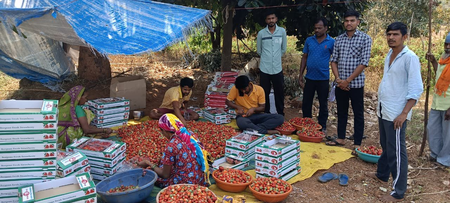
Gandhinagar, May 20 (IANS) Gujarat’s Dang district has emerged as the state’s leading strawberry-producing region, with cultivation expanding rapidly under the government’s natural farming initiative and farmers earning up to Rs 8 lakh annually per hectare.
According to official data, the area under strawberry cultivation in the tribal district has grown from 20 hectares in 2022-23 to nearly 33 hectares in 2025-26. Production has also witnessed a sharp rise, increasing from 140 metric tonnes in 2022-23 to 196 metric tonnes in 2024-25, and is projected to touch 233 metric tonnes in 2025-26.
Officials attributed the growth to favourable climatic conditions, increasing market demand, and the widespread adoption of chemical-free farming practices. Under the leadership of Chief Minister Bhupendra Patel, Dang was declared the country’s first natural farming district, encouraging large-scale participation by local farmers in sustainable agriculture.
The district’s cool climate and sandy-loam soil rich in organic matter are considered ideal for strawberry cultivation. Experts say the crop thrives in well-drained soil with a pH level between 5.5 and 7.0, along with 8 to 12 hours of sunlight required for flowering and fruit development. Day temperatures between 22 and 25 degrees Celsius and night temperatures ranging from 7 to 13 degrees Celsius are considered optimal.
Farmers in Dang are cultivating nine strawberry varieties, including Winter Dawn, Early Winter, Camarosa, Sweet Charlie, Nabila, Nabati, Selva, Belrubi, and Pajero. Among them, Winter Dawn has become the most preferred variety due to its high yield potential between December and February-March.
Large-scale cultivation has expanded across several villages in Ahwa taluka, including Bhurapani, Borigavtha, Galkund, Kotamdar, Malegaon, Sonuniya, and Vanar. In Waghai taluka, strawberry farming has spread to Kanchanpada, Ghodwahal, Murambi, and adjoining villages.
To support farmers, the state horticulture department has been organising training camps and educational tours focused on natural farming and modern cultivation practices. Subsidies ranging from 55 to 75 per cent are also being provided on strawberry saplings and cultivation-related expenses. Farmers are receiving assistance for mulching sheets, plastic covers, crates, packaging material, and farm equipment such as mini tractors, rotavators, cultivators, and trolleys.
Officials said many residents who earlier depended on labour work in industrial units and farms in Maharashtra have now shifted to strawberry farming due to its higher profitability.
Traditional crops such as paddy, nagli, urad, and varai earlier generated limited returns, but strawberry cultivation is now enabling farmers to earn between Rs 7 lakh and Rs 8 lakh annually per hectare.
Initially confined to local markets in Saputara and Ahwa, strawberries grown in Dang are now reaching larger markets in Ahmedabad, Surat, and Bharuch. Officials added that the expansion of cultivation has also created seasonal employment opportunities for local residents.
–IANS
sn/vd