
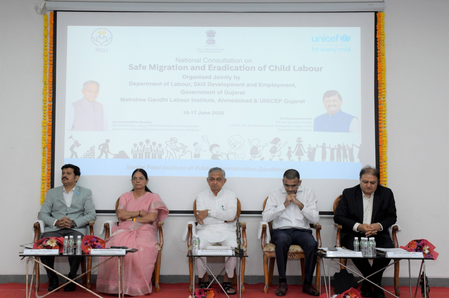
Gandhinagar, June 16 (IANS) Ensuring that children of migrant workers do not fall through gaps in education, healthcare and protection systems emerged as a key focus of a two-day inter-state dialogue on child labour and safe migration that began at the Sardar Patel Institute of Public Administration (SPIPA) in Gandhinagar.
Speaking at the inaugural session, Gujarat Labour, Skill Development and Employment Minister Kunvarji Bavaliya said migration remained essential to India’s economic growth but often exposed children to heightened risks of exploitation, trafficking and child labour.
“Safe migration and the elimination of child labour is a social, economic and humanitarian responsibility that all of us must fulfil together,” Bavaliya said, stressing that labour policy should extend beyond administrative structures to reach every worker’s family and child.
The workshop, organised on World Day Against Child Labour, brought together representatives from Gujarat, Rajasthan, Bihar, Maharashtra, Uttar Pradesh and Madhya Pradesh, along with policymakers, child rights organisations and subject experts to discuss strategies for preventing child labour and protecting vulnerable children.
Bavaliya said migrant workers played a critical role in driving growth across industry, construction, services and agriculture, describing them as pillars of nation-building.
He noted that Gujarat, as one of India’s leading industrial states, attracts lakhs of workers from across the country who contribute significantly to its economy.
However, he said: “Migration often disrupts children’s education, affects access to healthcare and leaves many outside social security and child protection systems. Such circumstances can create conditions that lead to child labour, child trafficking and other forms of exploitation.”
The minister said the state had strengthened district-level task forces working on the elimination of child and adolescent labour and improved coordination among government departments involved in the rescue, rehabilitation and reintegration of children.
Efforts were also underway to expand online registration of workers, awareness programmes and social security coverage.
“Eliminating child labour required more than legal enforcement and depended on ensuring every child had access to quality education, a safe environment, healthcare and equal opportunities for development,” he said.
Chairperson of the Gujarat State Commission for Protection of Child Rights, Dharmishtha Gajjar, described child labour as a direct assault on children’s rights, aspirations and future rather than merely a legal violation.
“Every child has an equal right to a safe childhood, quality education, protection and a life of dignity,” she said.
Gajjar said achieving the vision of a “developed India by 2047” would require children to be educated, protected and given opportunities to realise their potential.
She called for closer cooperation among governments, civil society organisations and community leaders to ensure that no child was forced into labour because of economic hardship.
Highlighting the need for greater inter-state coordination, she urged states to strengthen information-sharing systems, child tracking mechanisms and rehabilitation processes.
“Gujarat had prepared a ‘State Action Plan’ aimed at addressing risks associated with child labour and human trafficking,” she said.
Labour Commissioner K.D. Lakhani said child labour should be viewed as a wider social issue linked to education, nutrition, health and social security.
“Governments were implementing multiple schemes and policies to ensure that children of migrant families continued to receive educational and welfare support despite relocation,” he said.
Lakhani said discussions during the workshop would cover migration-related risks, legal and administrative mechanisms to prevent child labour, rescue and rehabilitation procedures, reintegration measures and community-based interventions.
The objective, he said, was to develop an effective roadmap towards a child labour-free society by learning from successful models and experiences across states.
Mahatma Gandhi Labour Institute Director General Pravin Solanki said child labour could not be separated from broader socio-economic realities.
“As India moved towards becoming a developed nation, eliminating child labour remained a critical challenge requiring joint action by governments and society,” he asserted.
Solanki noted that while legal frameworks were broadly similar across states, outcomes often varied, making it important for participants to exchange both successful and unsuccessful experiences during the discussions.
Dr Narayan Gavkar, Chief Field Office representative of UNICEF at the event, said Gujarat’s industrial growth attracted substantial migration from other states and emphasised that economic development should not come at the expense of children’s education, health or safety.
“UNICEF had worked with governments and institutions for years to prevent child labour and was focusing on strengthening families to reduce vulnerabilities, supporting adolescents through education and skills development, and ensuring uninterrupted access to schooling,” he said.
–IANS
mys/uk