
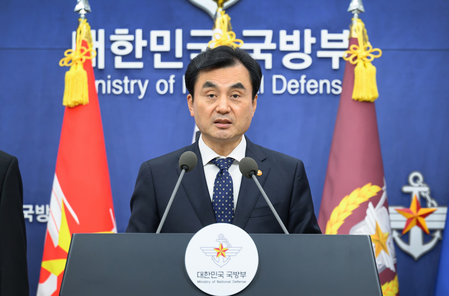
Seoul, Feb 21 (IANS) South Korea’s Defence Minister Ahn Gyu-back has lodged a protest with the United States Forces Korea (USFK) early this week over its brief standoff with Chinese fighter jets during a rare air exercise, military sources said on Saturday.
Defence Minister Ahn Gyu-back has delivered a complaint in a call with Gen. Xavier Brunson, the commander of the Combined Forces Command and the United States Forces Korea, immediately after he received a report of the incident on Wednesday, according to the sources.
Gen. Jin Young-sung, the chairman of the Joint Chiefs of Staff, also lodged a complaint in a call with Gen. Brunson, they added.
On Wednesday, US and Chinese fighter jets engaged in a rare standoff over the Yellow Sea during a training operation of the US Air Force, which involved some 10 USFK F-16 fighter jets, reports Yonhap news agency.
The F-16 jets reportedly flew to an area between the respective air defence identification zones of South Korea and China, prompting the Chinese military to dispatch its own fighter jets to the scene, but no clash occurred.
The USFK had notified the South Korean military of its plan ahead of the exercise, but apparently did not elaborate on the details, including the purpose of the drills, officials have said.
The latest drills come amid speculation that Washington will seek to redefine the role of the USFK as it pushes to focus on countering Chinese threats while urging allies to take on greater security burdens.
The US National Defence Strategy released last month signaled a possible shift in US force posture in South Korea, noting that the South is capable of taking “primary” responsibility to deter the North with “critical, but more limited” US support — a shift that it says is in line with America’s interest in “updating” US force posture on the Korean Peninsula.
USFK Commander Gen. Xavier Brunson has also mentioned the need for “flexibility” of the USFK as he introduced a map that puts the east at the top rather than standard north-up mapping.
“Forces already positioned on the Korean Peninsula are revealed not as distant assets requiring reinforcement, but as troops already positioned inside the bubble perimeter that the US would need to penetrate in the event of crisis or contingency,” he said, as he introduced the map on November 17 last year.
–IANS
sd/