
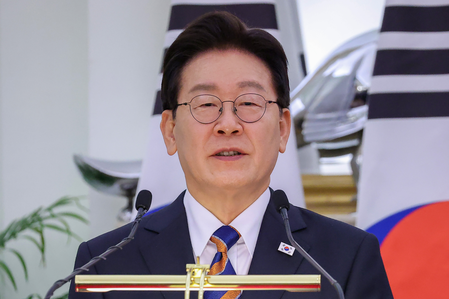
Seoul, Aug 4 (IANS) The South Korean Cabinet on Tuesday approved a recently passed legal revision abolishing prosecutors’ authority to conduct direct investigations, with President Lee Jae Myung calling it “the beginning of judicial normalisation.”
Presided over by Lee, the Cabinet approved the promulgation of the revision to the Criminal Procedure Act, which passed through the National Assembly last week in a vote boycotted by the main opposition People Power Party (PPP).
The bill strips prosecutors of their authority to conduct direct investigations, including supplementary investigations, leaving investigative authority solely with the police, Yonhap News Agency reported.
Should a supplementary investigation be needed, the prosecution can request the police to carry out such investigations, which will then have up to two months to complete their investigations.
At the opening of the Cabinet meeting, Lee defended the revision as “the beginning of judicial normalisation,” signalling his intention to sign the bill into law despite calls from the opposition party to veto it.
“Separating investigations from indictments is the starting point for normalising the abnormal criminal justice system,” Lee said.
The approval came one day after the PPP held a meeting of its Supreme Council just outside of Cheong Wa Dae, urging the president to veto the revision that it argued would only benefit criminals.
The president noted that the presidential veto power should be exercised only when the constitutional order is at risk, or the separation of powers among the legislative, judicial and executive branches is threatened, adding that the bill does not warrant its use.
“There were many controversies, but it is difficult to view this as a serious enough situation where this revision can be viewed unconstitutional, or as infringing on the executive branch’s authority or running counter to our national interest that parliament’s legislative authority should be denied,” he said.
Lee asserted that prosecutors have exercised “excessive” authority ranging from indictments to the right to request court warrants over the past several decades, leading to what he called an abnormal system in which they sometimes have abused their power to cover up or target certain cases.
Still, the transferring of investigative authority solely to the police could also create unintended consequences, the president warned, instructing officials to devise complementary systems to ensure transparency and capability in police investigations.
The president said prosecutors should remain more faithful than ever to their role as chief defenders of the public interest and human rights, while the police need to redouble efforts to eradicate internal irregularities and strengthen the protection of victims.
“No reform can be completed easily through the change of a single system,” Lee stressed, instructing officials to thoroughly oversee the implementation of the new system and to promptly address any shortcomings when detected.
The president also ordered thorough measures to safeguard people’s lives amid the continuing heat wave.
South Korea continued to struggle with an unprecedented heat wave this week, with many parts of the nation reporting record high temperatures exceeding 40 C as of Monday.
“Considering the current situation as a state disaster, utmost efforts should be made to protect people’s lives by taking necessary measures promptly and thoroughly,” he said.
The president, in particular, emphasised the need for special protection for underprivileged people and workers labouring outdoors or in closed spaces.
He instructed officials to ensure that workers can exercise their rights to suspend work over excessive heat, while expanding heat shelters and public access to them.
–IANS
akl/