
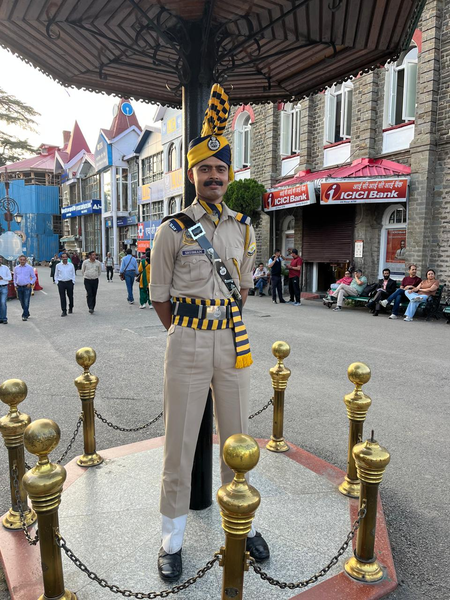
Shimla, May 21 (IANS) In a hill town defined by its steep slopes, colonial-era charm and constant tourist footfall, the heaviest traffic in Shimla often moves on foot.
And standing guard over this slow-moving human river at Scandal Point, the famous promenade where the Ridge and the Mall (road) converge, are tall men and women of Himachal Pradesh Police in ceremonial attire — immaculate turban, polished presence, and a job description that expands dramatically with the tourist season.
This unique force regulates wandering crowds, rescues pedestrian flow from selfie-induced paralysis, and politely endures an endless parade of visitors who want not directions, but photographs with them.
They are now woven into the endless memories tourists carry home — frozen in selfies, smiles and countless social media posts.
“Clad in their formal uniform, their discipline, courtesy, and vigilance instill a sense of confidence in the minds of every tourist and citizen. With every patrol, they not only ensure safety but also set a benchmark for professional and friendly policing,” reads a state police post on Facebook.
Their duty is crowd management by advising pedestrians to move on the left side of the Mall, the auto-free zone. Their duty gets challenging with the arrival of a madding crowd, especially during the tourist season.
“We really feel elated with the warmth of two strolling police women who accepted our request to have a selfie with us. Their cheerful faces have won our hearts, and we are taking these memories of Shimla to our hometown,” Ankita Chatterjee, a tourist from Kolkata, told IANS.
Another tourist, Yoshita Gupta, added, “The intimidating mustaches sported by a policeman are an iconic element of creating a sense of fear among the mischievous elements.”
More than 75 years after the British left, the Queen of the Hills, as Shimla was popularly known, still attracts thousands of domestic and overseas tourists. Many of the foreign tourists are descendants of Englishmen who lived here during British rule.
Shimla has several auto-free zones to facilitate unrestricted movement of pedestrians. The strolling culture of Shimla, which served as the summer capital of British India between 1864 and 1939, was developed by the colonial rulers. The Mall and the historic Ridge, an open space just above the Mall and now a hub of commercial activity, were once ‘British only’ streets meant for strolling.
Favouring the practice of auto-free zones, the Himachal Pradesh High Court has observed on several occasions that Shimla is a pedestrian city and the walkers have the right to walk freely. The High Court, on several occasions, asked the government if the provisions of the Shimla Roads Users and Pedestrians (Public Safety and Convenience) Act, 2007, are being enforced or not.
Irked over the illegal parking of tourist vehicles in auto-free zones on New Year’s Eve, the High Court had even summoned top administrative and police officials. “We were shocked to find that vehicles were parked in the sealed and restricted areas. Not only this, but vehicles were also parked in the core area of Shimla town,” a division bench of Justice Deepak Gupta and Justice Sanjay Karol had observed in January 2012.
In its earlier order on the same petition, the court had frowned upon Indian Army vehicles plying in the town, particularly on the restricted routes, without valid permits. The army has its offices located in the heart of the state capital. “The army officials are also the citizens of India, like all other citizens. They also have to go to the office like any other government officials, and if they choose not to walk… if they are using the sealed/restricted roads, they may only do so after taking (vehicle) permits under the act,” the judges had observed.
A strong advocate of auto-free zones, Chief Justice Kurian Joseph himself favoured the creation of more auto-free zones in Shimla to facilitate irritation-free movement of pedestrians. He believed Shimla is an ideal place where a walk not only helps an individual to remain healthy but also helps reduce vehicular congestion and pollution.
(Vishal Gulati can be contacted at vishal.g@ians.in)
–IANS
vg/skp