
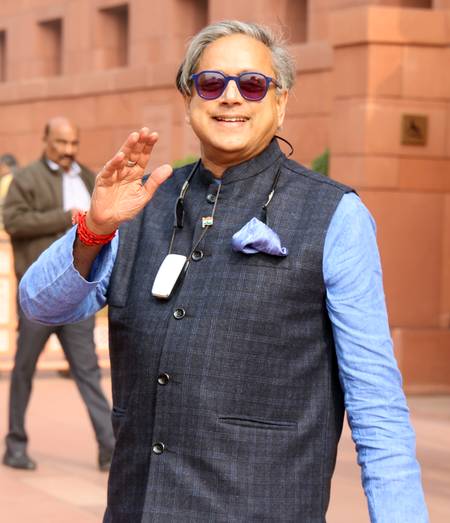
New Delhi, Jan 23 (IANS) Congress MP Shashi Tharoor chose to commit – unknowingly or not – at least two cardinal sins against his party’s topmost echelons in the recent past. leading to its leadership reportedly ignoring or belittling him, which has been the case earlier with several others associated with the party.
Lately, the four-time Thiruvananthapuram MP is said to be upset being made to speak ahead of others junior to him after being reportedly told that he was ahead of only Rahul Gandhi himself.
And while beginning his address at the Kochi event, the Gandhi scion apparently skipped Tharoor’s name.
Earlier, the diplomat-writer received brickbats from party colleagues for positive comments in favour of Prime Minister Narendra Modi’s handling of national issues, including conducting Operation Sindoor in retaliation for the April 2025 Pahalgam terror attack.
His social media post, featuring an ‘ussie’ with India men’s cricket team coach Gautam Gambhir, calling him “the man with the hardest job in India after the PM’s”, too did not go down well with the party.
His first cardinal sin can be the one where he chose to contest against the Congress first family’s choice for party President, Mallikarjun Kharge. Things have never been the same for him.
His cardinal sin two may be ascribed to praising anything to do with the present regime or its leader.
Rahul Gandhi has been raising his voice against alleged “vote theft” or the purported hijacking of popular mandate in favour of the ruling Bharatiya Janata Party (BJP), but within the Congress, the Gandhi family appear to control party elections. In November 2000, Jitendra Prasada attempted to contest the then-Presidential election against Sonia Gandhi, campaigning on the need for internal democracy and a more consultative style of leadership.
Following this, reports said that he was left politically isolated within the party. Two months later, he passed away following a cerebral haemorrhage.
There are also the cases of Rajesh Pilot and Ghulam Nabi Azad, where apparent internal dissent or challenge to the High Command reportedly resulted in political marginalisation or disciplinary actions within the Congress. Azad was among the group of 23 Congress leaders seeking an organisational overhaul about four years ago, where they were termed rebels and as working at the BJP’s behest.
In early 2024, Prime Minister Modi recounted in a Rajya Sabha speech how the Congress insulted its former President Sitaram Kesri, an OBC leader, who was elected to the party’s top post in 1996 after P.V. Narasimha Rao stepped down.
Kesri’s presidency was marked by internal challenges and controversies, where his leadership faced criticism for lacking mass appeal and causing fractures within the party.
Eventually, Kesri was replaced by Sonia Gandhi in 1998 in what was then called a “bloodless coup”. He reportedly remained locked inside Congress headquarters during the transition. This event, recount some, symbolised growing dissatisfaction with his leadership, while others point to the party’s shift towards dynastic control under the Gandhi family.
Kesri was allegedly further sidelined in later time. Narasimha Rao, hailed as the architect of India’s economic liberalisation in the early 1990s, is often viewed as one of the most consequential Prime Ministers. However, after his tenure, the Congress reportedly neglected his contributions, sidelined him within party ranks, and distanced itself from his legacy. He slowly faded into oblivion from public life, and after he died in 2004, he was controversially denied the honour of having his body brought to Congress headquarters for public homage, and his cremation was conducted in Hyderabad rather than Delhi, where he had served prominently.
Such actions are alleged in certain quarters as reflective of the Congress’s dynastic politics, prioritising family loyalty and limiting the influence of leaders who operated independently of the Gandhi family.
–IANS
jb/vd