
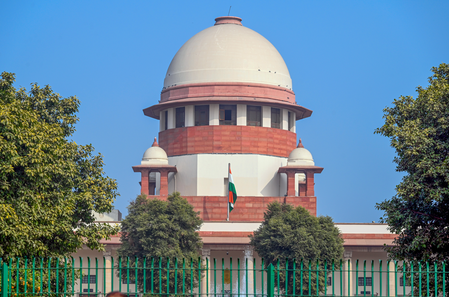
New Delhi, April 2 (IANS) The Supreme Court on Thursday took serious exception to an incident in West Bengal’s Malda district where judicial officers deputed for work relating to the Special Intensive Revision (SIR) of electoral rolls were allegedly gheraoed and attacked, observing that it was a “brazen attempt” to browbeat the judiciary and a direct challenge to the authority of the apex court.
A Bench of Chief Justice of India (CJI) Surya Kant and Justices Joymalya Bagchi and Vipul M. Pancholi, hearing a suo motu writ petition titled In Re: Safety and Security of Judicial Officers Deputed for Work Relating to SIR of Electoral Rolls in the State of West Bengal and Ancillary Issues, issued a slew of directions to ensure the safety of judicial officers and the smooth continuation of the ongoing SIR process in the state.
Taking note of a letter received from the Chief Justice of the Calcutta High Court detailing the incident, the apex court recorded that seven judicial officers, including three women, were gheraoed by anti-social elements at a BDO office in the Kaliachowk area from around 3.30 p.m., and were released only after midnight.
“We are informed that the situation was so dire that even food and water were not permitted to be supplied to the judicial officers,” the CJI Kant-led Bench noted.
The apex court further observed that despite being alerted, the response of the civil and police administration was marked by “conspicuous inertia”, with no effective intervention for several hours.
“Ultimately, the judicial officers were released after 12 midnight. Shockingly, when the judicial officers were returning to their respective places of stay, their vehicles were pelted with stones and attacked with bamboo sticks and bricks,” the order recorded.
“In our considered view… the incident that took place yesterday is a brazen attempt not only to browbeat judicial officers, but also amounts to a challenge to the authority of this Court,” the CIJI Kant-led Bench observed, adding that the episode appeared to be a “calculated, well-planned and deliberate act intended to demoralise judicial officers”.
Expressing anguish over the conduct of the state machinery, the apex court remarked that the response of the civil and police administration reflected a “complete failure” in maintaining law and order.
“It also pains us to observe that the manner in which the Chief Secretary, the Home Secretary, the Director General of Police, the Collector and the Superintendent of Police have acted is have acted is highly deplorable,” the CJI Kant-led Bench said, directing them to explain why no effective steps were taken despite being informed of the situation in the afternoon.
“They owe an explanation to this Court as to why, upon being informed that the judicial officers had been gheraoed at around 3.30 p.m., no effective measures were taken to secure their safe evacuation,” the apex court said, directing them to show cause why action should not be initiated.
“We have no hesitation in observing that we will not permit any person to take the law into their own hands so as to create a climate of psychological fear in the minds of judicial officers,” it said, adding that such acts would amount to criminal contempt under the Contempt of Courts Act, 1971.
To prevent any recurrence and ensure the safety of judicial officers, the Supreme Court directed the Election Commission of India (ECI) to requisition and deploy adequate central forces at all locations where such officers are posted.
It further ordered that comprehensive security arrangements be made at all venues as well as at places of stay of the officers and their families, and directed authorities to assess and address any threat perception.
In a significant measure, the top court directed that not more than five persons be allowed to enter premises where objections under the SIR process are being adjudicated at any given time, and that strict crowd control measures be enforced.
The CJI Kant-led Bench also directed the ECI to entrust the probe into the incident to an independent agency such as the CBI or the NIA, and asked for a preliminary inquiry report to be submitted directly before it.
Additionally, compliance reports have been sought from the Chief Secretary, Director General of Police and Chief Electoral Officer of West Bengal. The apex court ordered that all concerned officials remain present virtually on the next date of hearing on April 6.
–IANS
pds/pgh