
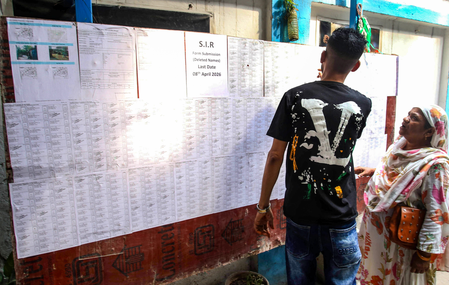
New Delhi, May 27 (IANS) The Supreme Court, while upholding the validity of the Election Commission’s Special Intensive Revision (SIR) exercise, on Wednesday directed that persons whose names have been deleted from the 2003 electoral roll on the ground of doubtful citizenship must be referred within four weeks to the competent authority under the Citizenship Act, 1955, for adjudication.
A Bench of Chief Justice of India (CJI) Surya Kant and Justice Joymalya Bagchi clarified that the competent authority must decide such cases in accordance with law, preferably before the next Parliamentary, Assembly or local body elections, after giving notice and an opportunity of hearing to the affected individuals.
“In the event the competent authority holds that such deleted individuals are citizens, they shall be included in the electoral roll,” it said.
What did the SC say on citizenship scrutiny?
In its detailed judgment, the top court held that the Election Commission of India (ECI) is empowered to undertake a limited enquiry into citizenship for the purpose of determining eligibility for inclusion in electoral rolls.
However, it drew a distinction between an adjudication of citizenship and an administrative satisfaction for electoral purposes.
“Such an enquiry does not amount to a determination of citizenship in the strict sense, and any action taken pursuant thereto is confined to electoral consequences alone,” the CJI-led Bench said.
It added that exclusion from the electoral roll does not divest an individual of citizenship claims, nor does it foreclose a formal determination by the competent authority under the Citizenship Act. Rejecting the contention that the ECI had usurped powers reserved for the Union government under the Citizenship Act, the apex court held that the poll body’s inquiry was confined only to electoral consequences and did not amount to a declaration that an individual was not a citizen of India. “It merely reflects the Commission’s inability to be satisfied, for electoral purposes, that the statutory conditions are met,” the bench clarified.
What happens if ECI is not satisfied?
The apex court said that where the poll body is not satisfied that a person meets the statutory conditions for inclusion, it can decline enrolment or initiate deletion, but such action is limited in scope. Importantly, it made it mandatory for the ECI to refer such cases to the Central government’s competent authority for a final decision on citizenship. “The Commission’s determination, being confined to electoral purposes, cannot assume finality on the question of citizenship. Any deletion effected on this ground shall, therefore, remain subject to the outcome of such adjudication by the appropriate authority,” the bench held.
Are non-citizens entitled to vote?
The apex court said that Section 16 of the Representation of the People Act (RP Act) explicitly disqualifies non-citizens from being registered in electoral rolls, and therefore, the ECI could not discharge its constitutional obligation without satisfying itself that persons included in the rolls fulfilled this threshold requirement. At the same time, the Supreme Court underlined that citizenship was “not a matter of mere formal classification” but the juridical basis of an individual’s relationship with the government, carrying implications for dignity, identity and constitutional status. “Any process that touches upon this domain must, therefore, be approached with a high degree of procedural fairness and institutional restraint,” the judgment said. It reiterated that persons whose names had been erroneously deleted on grounds such as being absent, dead, shifted or duplicated could seek judicial review.
What was challenged?
A batch of petitions had questioned whether the SIR exercise effectively enabled a broad scrutiny of citizenship, which, according to the petitioners, fell exclusively within the domain of the Central government under the Citizenship Act and the Allocation of Business Rules. Rejecting this contention, the Supreme Court held that the ECI’s power flows from its constitutional mandate under Articles 324, 325 and 326, read with Section 16 of the Representation of the People Act, 1950, which disqualifies non-citizens from being registered as electors. It said that maintaining the accuracy of electoral rolls necessarily entails verifying whether a person satisfies eligibility conditions, including citizenship.
What did SC rule overall?
Upholding the SIR exercise, the top court ruled that it neither violates the statutory framework nor the constitutional mandate of free and fair elections.
“The impugned SIR exercise… is undertaken to advance the objective of ensuring the accuracy, completeness and integrity of electoral rolls,” the CJI-led Bench held. It further held that the exercise satisfies the test of proportionality, noting that the measures adopted bear a rational nexus to the objective sought to be achieved and are accompanied by sufficient procedural safeguards. On the documentation framework, the apex court said that the classification of documents prescribed by the ECI is based on intelligible criteria and cannot be termed arbitrary.
Background of the matter
The judgment came on petitions challenging the SIR exercise initiated by the ECI, beginning with Bihar and later extended to several states, amid concerns that the process could lead to exclusion of genuine voters, particularly among marginalised and migrant populations. The poll body had defended the exercise, stating that it was aimed at preventing duplication and ensuring the purity of electoral rolls. Disposing of the batch of pleas, the apex court held that while inclusion in the electoral roll carries a presumption of validity, such presumption is rebuttable and does not bar the ECI from undertaking a special revision.
–IANS
pds/vd