
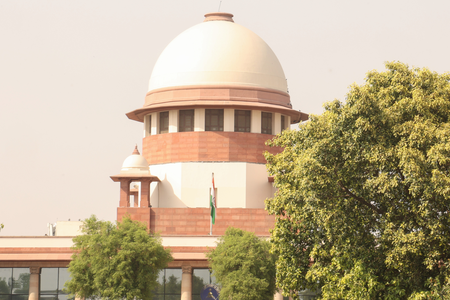
New Delhi, Oct 27 (IANS) The Supreme Court on Tuesday questioned the Centre over its decision to cap trade margins on anti-cancer medicines at 30 per cent, asking why the government had taken so long to act on the issue and expressing concern over the substantial mark-ups charged by private hospitals on medicines and medical consumables.
A Bench of Justices Vikram Nath and Sandeep Mehta said the issue concerned patients’ lives and could not be viewed merely through the prism of commercial interests and economic policy. “Why did you suddenly decide to cap the trade margin on cancer medicines at 30 per cent? Why were you silent for so many years? Do not force us to ask harsh questions. You are dealing with matters concerning people’s lives. Do not treat this as a business,” the Justice Nath-led Bench told the Centre.
The apex court made the observations while hearing public interest litigations (PILs) concerning the regulation of medicine prices, generic medicines, medical devices and prescription practices.
The apex court expressed dissatisfaction with the Centre’s explanation that the decision to cap trade margins was aimed at balancing the interests of various stakeholders. It also questioned the burden placed on patients when government-backed health schemes like Ayushman Bharat provide reimbursement only up to a specified limit, observing that the additional expenditure ultimately had to be borne by patients themselves.
It further raised concerns over the substantial mark-ups charged by hospitals on medical consumables, citing the example of a saline drip line that costs a retailer around Rs 15 but is billed to patients at Rs 250. “Why is the DPCO in place if this is what is happening? The government itself is allowing this to happen,” the Supreme Court observed, referring to the Drug Price Control Order (DPCO), which provides the regulatory framework for controlling drug prices.
The Justice Nath-led Bench also referred to an incident involving a drug dealer whose wife was undergoing cancer treatment at a prominent private hospital. It said the dealer had informed the hospital that he could procure a chemotherapy injection at a dealer price of Rs 11,000, but the hospital refused to administer the medicine and instead charged Rs 1.30 lakh for the same injection.
“Can you show any justification for this loot, please? Why this difference? Where does the money go?” the Supreme Court asked.
Appearing for the private hospitals, senior advocate Mukul Rohatgi argued that hospitals needed to procure medicines through their own pharmacies to ensure the availability and quality of drugs administered to patients. The senior counsel submitted that hospitals had to maintain infrastructure and facilities round the clock and that medicines available in the market could not always be trusted to be genuine.
Rohatgi also contended that reducing medicine prices would not necessarily bring down the overall cost of treatment, as hospitals would have to recover their operational expenses through other means.
However, the Justice Nath-led Bench rejected the justification, observing that hospitals could recover their costs through legitimate means rather than imposing excessive mark-ups on medicines. “A hospital can survive through other means, not through this dacoity. You are a commercial hospital. You charge for everything. But why should a medicine be quoted at 100 or 200 times its price?” the apex court asked.
The Centre had earlier informed the Supreme Court that capping trade margins on anti-cancer medicines at 30 per cent of their maximum retail price (MRP) was expected to save patients around Rs 2,500 crore annually.
In an affidavit filed before the top court, the Department of Pharmaceuticals said the proposed measure could reduce the MRP of cancer medicines by 20 to 70 per cent, depending on the drug. The government had said the move was intended to curb excessive trade mark-ups while retaining reasonable margins for distributors and retailers.
It had also referred to an earlier intervention in 2019, when the National Pharmaceutical Pricing Authority (NPPA) imposed a 30 per cent trade margin cap on 42 selected non-scheduled anti-cancer medicines.
According to the Centre, the measure led to reductions in the MRP of 526 brands and generated estimated annual savings of around Rs 984 crore for patients.
The Supreme Court has now concluded the hearing and reserved its verdict in the matter. It has also directed all parties to file their written submissions.
The PILs have raised concerns over the existing medicine pricing framework and sought more effective regulation of the disparity between the prices at which medicines are supplied to retailers and the amounts ultimately charged to patients.
–IANS
pds/uk