
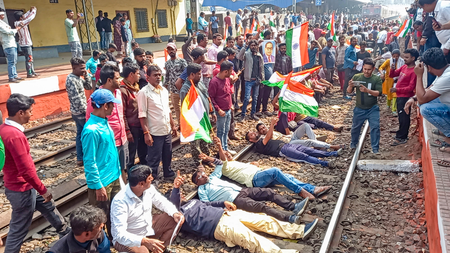
New Delhi, Feb 9 (IANS) The Supreme Court on Monday issued a show-cause notice to West Bengal’s Director General of Police (DGP) in response to the Election Commission of India’s (ECI) allegations of intimidation and disruption during the ongoing Special Intensive Revision (SIR) of electoral rolls in the poll-bound state.
A bench headed by Chief Justice of India (CJI) Surya Kant ordered the state police chief to file a personal affidavit explaining the allegations levelled in the poll body’s counter affidavit that, despite complaints by poll officials, no FIRs were registered against those allegedly involved in burning objection forms and records linked to the SIR exercise.
“Though this is being strongly refuted by the state government, we are reminded of our 19 January order, in which a categorical direction was issued to police authorities to ensure maintenance of law and order. We deem it appropriate for the DGP to explain his response,” observed the Bench, also comprising Justices Joymalya Bagchi and N.V. Anjaria.
To streamline the ongoing SIR process in West Bengal and to address the apprehensions raised by the petitioners opposing the revision exercise, the Supreme Court issued a slew of interim directions.
The CJI-led Bench directed the West Bengal government to ensure that all 8,505 Group B officers, whose list was handed over to the top court during the hearing, report to the District Electoral Officers (DEOs) or Electoral Registration Officers (EROs) by 5 p.m. on Tuesday.
The apex court granted discretion to the ECI to replace the existing EROs and Assistant EROs (AEROs) and utilise the services of the newly made available state government officers, if they are found qualified and suitable.
After a brief scrutiny of their biodata and work experience, these state government officials may be imparted one or two days of training and deployed to assist the EROs/AEROs.
The Supreme Court categorically clarified that micro-observers and state government officials shall only assist the statutory authorities, and that the final decision-making power will rest solely with the EROs.
Taking note of submissions that the induction of a new set of officials could delay scrutiny of documents submitted by affected voters, the CJI-led Bench directed that the EROs be granted at least one additional week beyond February 14 to complete the scrutiny and take appropriate decisions.
In its order, the apex court recorded the ECI’s clarification that micro-observers are not decision-making authorities and are only meant to assist the statutory authorities.
The Supreme Court also took note of the poll body’s submission that there were erring officials against whom recommendations for suspension had been made, but no action was taken by the state government.
It was also highlighted that when certain officers were needed for the SIR exercise, they were transferred.
At this, the bench asked the Secretary to the Chief Minister to look into the issue, observing that when suspension advice is given, the state government “ought to know what to do”.
The apex court ordered that the ECI shall be at liberty to replace officers who are not performing their duties.
–IANS
pds/vd