
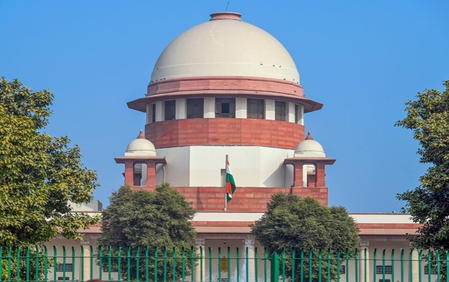
New Delhi, Feb 6 (IANS) The Supreme Court on Friday asked the National Board of Examinations in Medical Sciences (NBEMS) to file an affidavit explaining the reasons behind its decision to reduce the minimum qualifying cut-off percentiles for the NEET-PG 2025–26 examination.
A Bench of Justices P.S. Narasimha and Alok Aradhe remarked that the apex court would examine whether the decision taken was “drastically wrong”.
The Justice Narasimha-led Bench was hearing a public interest litigation (PIL) challenging the January 13 notification issued by NBEMS, which reduced the qualifying cut-off percentiles for postgraduate medical admissions to abnormally low, zero, and even negative levels after the declaration of results and completion of two rounds of counselling.
Senior advocate Gopal Sankarnarayanan, appearing for the petitioners, submitted that nearly 80,000 postgraduate medical seats are available while over 1.28 lakh candidates fall within the qualifying percentiles of various categories, and that the authorities must explain the rationale for reducing the cut-off so drastically.
“You cannot go all the way down to minus 40 marks, which means if they didn’t sit for the exam, they would be in a better position,” he argued.
After hearing the submissions, the Justice Narasimha-led Bench observed that the Supreme Court was conscious of the tension between ensuring that postgraduate medical seats do not go to waste and maintaining academic standards.
“On the one hand, we have this competing value to protect — that seats should not go to waste. At the same time, there is pressure that candidates are not coming, so please reduce the cut-off,” the apex court said.
“So somewhere there has to be a balance,” it said, while clarifying that the top court’s conscience must be satisfied that there was “no devious reason” behind the impugned decision.
The Supreme Court subsequently directed NBEMS to place on record an affidavit explaining the reasons for the reduction of qualifying percentiles.
Earlier, on Wednesday, the Justice Narasimha-led Bench had issued notice in the matter and had sought responses from the Union government, NBEMS, the National Medical Commission and the Medical Counselling Committee.
According to the petition, the cut-off for General and EWS candidates was lowered from the originally prescribed 50th percentile (276 marks out of 800) to the 7th percentile (approximately 120 marks), while for SC, ST and OBC candidates, the qualifying percentile was reduced from the 40th percentile (235 marks) to zero percentile, permitting eligibility even with negative scores.
The plea, filed by advocate Satyam Singh Rajput, contended that the impugned reduction is arbitrary, unconstitutional and violative of Articles 14 and 21 of the Constitution, and poses a serious threat to patient safety, public health and the integrity of postgraduate medical education.
It argued that permitting candidates with zero or negative scores to enter specialist training dilutes merit at the apex level of medical education and undermines minimum standards of professional competence.
Terming the move “unprecedented and extreme”, the petition stated that NEET-PG, which is meant to function as a national screening mechanism, has been converted into “an instrument certifying failure as eligibility”.
The petitioners have also challenged the reduction on the ground that the “rules of the game” cannot be altered after the selection process has commenced and results have been declared.
It further alleged that the decision amounts to impermissible executive interference in academic standards, asserting that under the National Medical Commission Act, 2019, the responsibility to maintain professional standards lies with the NMC as an expert body, and cannot be subordinated to administrative or seat-filling considerations.
Seeking quashing of the impugned notification, the petitioners have urged the apex court to restore constitutionally permissible minimum qualifying standards and issue appropriate directions to safeguard patient safety, public health and the rule of law.
–IANS
pds/dan