
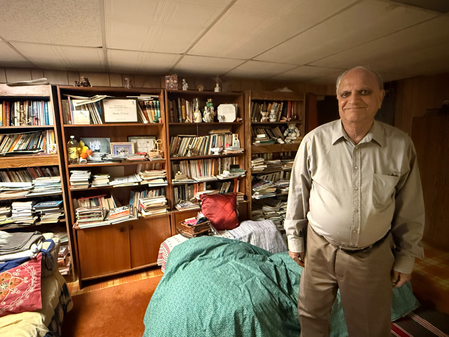
Chicago, Oct 5 (IANS) More than a decade of research across archives in India, Britain and the United States has led Indian-American scholar Sridhar D. Damle to a portrait of Vinayak Damodar Savarkar that he says is strikingly different from the political images built around one of modern India’s most contested figures.
Damle, a long-time scholar of the Rashtriya Swayamsevak Sangh (RSS), is completing a book on Savarkar after examining tens of thousands of pages of archival material, including British intelligence records, US diplomatic papers, banned literature, court-related material and Indian police files.
In an hour-long interview with IANS, Damle said his research began in 2010 and eventually expanded across archives and collections in India, Britain, the United States and elsewhere. He said he has collected more than 30,000 pages showing how governments, diplomats, police and others viewed Savarkar.
“Savarkar was a unique personality in the freedom struggle, as a social reformer, as well as the scientific mind combination,” Damle said, describing him as a visionary, practical politician and idealist.
One discovery Damle considers particularly significant is a 1906 document from Savarkar’s London years. He said a copy survived in British-confiscated material that he later found on microfilm at the University of Chicago.
According to Damle, the document envisaged an independent India based on democracy, equality before law, merit in public employment and one person, one vote. It left the future choice between a president and a monarch to a constituent assembly, he said.
“That India will be free, there will be democracy, there will be one man, one votes, equality before the law, job according to merits,” Damle said, describing the contents of the document.
For Damle, 84, that document is central to understanding a Savarkar who is often viewed almost entirely through later arguments over Hindutva, Hindu nationalism, Partition and the assassination of Mahatma Gandhi.
He said Savarkar’s views must be read in the context of different phases of his life — as a revolutionary under British rule, a prisoner in the Andaman Islands, a restricted political figure in Ratnagiri and later a Hindu Mahasabha leader.
Damle also challenged the popular characterisation of Savarkar’s petitions to the British authorities from prison as simple acts of capitulation. He said the petitions have to be understood within the prison system and the legal categories the colonial authorities applied to him.
“He ask as a prisoner, I write I’m asking. And all the papers, the six papers are there. British refusing,” Damle said.
He cited Savarkar’s argument that if the British treated him as an ordinary criminal, he should receive rights available to such prisoners, while if they treated him as a political prisoner, he should receive the corresponding political-prisoner rights.
Another major part of Damle’s research concerns the Gandhi assassination case. Savarkar was prosecuted but acquitted by the trial court. Damle said archival material he examined includes the raw report of the police investigation and a US diplomatic account of a conversation involving the government’s chief prosecutor.
Damle said he found a report in Washington recording that, early in the trial, the chief prosecutor told the American ambassador that Savarkar was likely to be freed because the prosecution lacked sufficient grounds against him.
“Daptari told American Ambassador Sauerka will be free very soon because there is no ground,” Damle said, recounting what he says the diplomatic document recorded.
Damle’s interpretation is that the archival trail raises serious questions about efforts to implicate Savarkar personally in the assassination. He distinguished Savarkar from followers who were involved and said political association by itself could not establish responsibility.
The scholar also presents Savarkar as a committed democrat after independence. Damle’s evidence is partly personal.
As a college student, Damle met Savarkar on January 14, 1960, after drawing his attention to a derogatory reference in a biography. He expected a brief encounter. Savarkar spent about an hour with him.
Damle recalled asking why Savarkar had criticised the dismissal of Kerala’s elected Communist government. Savarkar’s response, he said, was that accepting democracy meant accepting election results and changing governments through elections rather than executive intervention.
“Democracy is the best way in all, all of the form of government,” Damle recalled Savarkar saying. He also recalled Savarkar arguing that secret societies and political violence had no place in a democratic country after independence.
Damle’s research also highlights a less familiar Savarkar: an agnostic and rationalist who regarded religious texts as human creations rather than infallible authority.
“He believe all the religions are manmade, all the holy books are manmade,” Damle said. Savarkar, he added, respected India’s cultural inheritance but believed the ultimate test should be science and human welfare.
“Final word will be science, humanitarian-based science,” he said.
That portrait sits alongside Savarkar’s advocacy of Hindutva and Hindu organisation. Damle said Savarkar believed India’s minorities should have equal citizenship, religious freedom and protection of their culture, while remaining part of a united Indian nation.
Damle said Savarkar opposed Partition and feared Congress might ultimately accept it. He also said archival and published material showed exchanges with B.R. Ambedkar over the Partition question.
The book will also examine Savarkar’s thinking on national security and geopolitics. Damle said Savarkar later warned about China and the strategic consequences of developments in Tibet, and regarded buffer states as important to Indian security.
His research has also taken him into unexpected corners of transnational anti-colonial politics. In files of the Irish-American weekly Gaelic American, Damle found Savarkar’s writings from London, including an appeal to Indian Muslims to join the freedom struggle, an article on the Khalsa and a call for colonised peoples to unite against imperialism.
Damle said the material showed connections between Indian nationalism and international anti-colonial networks that have received less attention in popular accounts of Savarkar.
He is still trying to obtain documents before completing the manuscript. One unresolved battle is over Mumbai CID material. Damle said he located about 850 pages relating to Savarkar but has struggled to secure copies of records he believes should be open to researchers.
“The problem is still the bureaucracy,” he said.
Among the papers he wants is a four-page CID document relating to Savarkar’s arrest in 1950. Damle said his broader objective goes beyond publishing a book. After completing his research, he wants to place the documentation online for students, journalists and readers.
“My goal, after as soon I get a documentation, I want to put all my documentation online,” he said.
Damle also argues that Savarkar’s social-reform record deserves greater attention. He points to his campaign against untouchability and caste barriers, his support for inter-caste marriage and reconversion, and his effort to popularise modern terminology in Marathi. Damle said Savarkar coined scores of accessible terms for modern public life.
He said Savarkar’s personality cannot be reduced either to reverence from supporters or denunciation by opponents. His research, he said, instead points to a political figure whose ideas shifted with circumstances but whose recurring concerns included national unity, modernisation, science, social reform, military preparedness and democratic government.
Damle is an independent scholar based in the United States and is best known for his work on the RSS. With Walter K. Andersen, he co-authored “The Brotherhood in Saffron: The Rashtriya Swayamsevak Sangh and Hindu Revivalism” and, decades later, “The RSS: A View to the Inside”, examining the organisation’s history, structure and evolution.
Vinayak Damodar Savarkar, born in 1883, was an Indian revolutionary, writer and political leader who spent years imprisoned by the British, including in the Cellular Jail in the Andaman Islands. He later became president of the Hindu Mahasabha and was a principal exponent of Hindutva. Charged in the conspiracy surrounding Gandhi’s 1948 assassination, he was acquitted at trial. He died in Mumbai in 1966.
–IANS
lkj/ksk/rs