
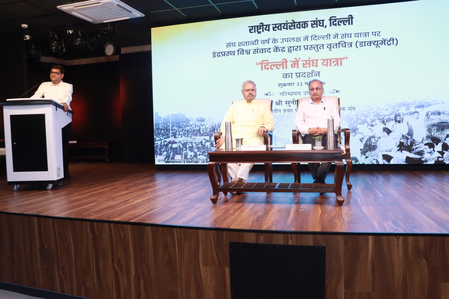
New Delhi, May 22 (IANS) Sunil Ambekar, the Akhil Bharatiya Prachar Pramukh of the Rashtriya Swayamsevak Sangh (RSS), said on Friday that between 1942 and 1947, the Sangh had expanded rapidly and deeply across Delhi and the entire Punjab region.
A large number of people had joined the Sangh and begun working with it. However, at the time of the country’s partition, the Sangh did not possess sufficient strength. Otherwise, Ambekar said, the partition of the nation would not have taken place.
He was speaking in Delhi on Friday on the occasion of the screening of the documentary titled “Delhi Mein Sangh Yatra” (The Sangh’s Journey in Delhi), presented by the Indraprastha Vishwa Samvad Kendra.
Sunil Ambekar noted that, as also depicted in the documentary, ‘Guruji’ (second RSS Chief M.S. Golwalkar) had issued a directive at that time, saying that the Hindus residing in the region that became the current day Pakistan following the Partition must be fully protected.
He added that the volunteers should stand their ground until the very last individual had arrived safely.
There is no count of the countless volunteers who sacrificed their lives, nor of the immense suffering endured by so many people during this endeavour.
Numerous camps were established for the displaced persons, providing shelter to hundreds of thousands of people.
During the first fortnight of August 1947, when everyone here was preoccupied with the widespread turmoil, the then RSS Chief Golwalkar was in Karachi, guiding the volunteers there on how to execute this massive task of ensuring the safety and security of the Hindu community.
Ambekar also remarked: “Had the Sangh or RSS founder KB Hedgewar intended to engage in politics, they would have simply launched a new political party. Instead, their objective was to build society and bring about a cultural awakening across the entire social fabric. It was for this very reason that the Rashtriya Swayamsevak Sangh was established. Its sole purpose was the service of society, the upliftment of society, the strengthening of society, and the empowerment of the entire nation to stand tall with self-confidence, relying entirely on its own inherent strength.”
The RSS’ Akhil Bharatiya Prachar Pramukh also said that the work of the RSS in Delhi had commenced during the very early stages of the organisation’s existence. Indeed, it was during the tenure of the first Sangh Chief, Dr. Hedgewar, that the organisation’s activities were initiated in Delhi.
Consequently, the Sangh’s work in Delhi is deeply and inextricably linked to the 100-year history of the organisation as a whole.
Over the course of these many years, Delhi has held a distinct significance in every major event that has occurred on the national stage, Ambekar added.
Naturally, the Sangh’s work in Delhi has also occupied a pivotal position and made a substantial contribution to this entire historical process. As the seat of power, Delhi has consistently remained the epicentre of party politics, a status it retained even after the attainment of independence.
“Within this specific context and during that particular era, the Rashtriya Swayamsevak Sangh, functioning as a socio-cultural organisation through its network of “shakhas”, embarked upon a mission to mobilise the entire society rather than confining itself merely to a few specific programs. This endeavour has continued uninterrupted to this very day,” Ambekar said.
Speaking on this occasion, Anil Agarwal, the Delhi Prant Sanghchalak of the RSS, remarked that continuity and adaptability are the defining characteristics of the Sangh’s work.
Ritesh Agarwal, the Delhi Prant Prachar Pramukh of the RSS, said: “This documentary, produced by the Indraprastha Vishwa Samvad Kendra, narrates the story of the Sangh in Delhi. It traces its journey from its initial inception to its subsequent expansion, drawing on a rich collection of evidence, personal recollections, and historical events.”
The film vividly portrays the genesis of the Sangh in Delhi as well as the work undertaken by the organisation amid the anguish and devastation of the Partition era.
Commencing with the establishment of Delhi’s very first shakha, the documentary chronicles the Sangh’s remarkable journey, culminating in its widespread presence and extensive reach across contemporary Delhi.
The RSS’ Delhi Prant Prachar Pramukh also highlighted the special commemorative issue titled “100 Years of National Service” published by the magazine “Apni Delhi Apni Baat” to mark the Sangh’s centenary year.
Ritesh Agarwal also elaborated that, in preparation for both the magazine’s special issue and the documentary, formal and informal interviews were conducted with more than 60 senior Sangh functionaries in Delhi.
More than 85 books were thoroughly studied, newspapers and articles were meticulously scoured, and archival material was gathered from various repositories.
As part of this process, more than 100 hours of video footage were reviewed.
Vintage videos and interviews from the archives of the Indraprastha Vishwa Samvad Kendra were examined.
The speeches, interviews, and available footage of former Sangh functionaries (activists) and Sarsanghchalaks (Chiefs) were also studied.
Ashok Porwal, Central Office Secretary of the RSS; Vishal, Delhi Prant Pracharak of the RSS; Rajesh, Delhi Prant Sah-Karyavah of the RSS; Dilip, Member of the Central Office Management Team of the RSS; Rajveer, North Zone Office Secretary of the RSS; and Ashok Sachdeva, President of the Indraprastha Vishwa Samvad Kendra, participated in the event, among others.
–IANS
sktr/khz