
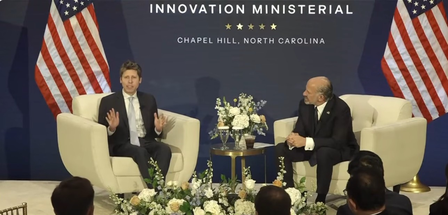
Chapel Hill (North Carolina), Sep 2 (IANS) OpenAI Chief Executive Sam Altman has warned governments against shutting artificial intelligence (AI) out of their countries, comparing such a move to rejecting electricity and saying that AI adoption is essential for economic growth and improved public services.
“I think it would be approximately as bad of an idea to say we’re not gonna have AI in our country as it was to say we’re not gonna have electricity in our country, you know, back 100 plus years ago,” Altman said during a fireside chat with US Commerce Secretary Howard Lutnick.
Addressing representatives of G20 economies, Altman said governments could adopt different regulations and decide whether to build or rent data centres.
But using the technology, he added, was no longer optional.
“For sure, I think it is not negotiable. You have to use it,” he said.
“The economic growth and benefit to people that can come from this, the value to a country is too high to ignore.”
Altman predicted that artificial intelligence would generate an unprecedented expansion in entrepreneurship and small businesses by giving people access to expertise, software and other resources that were previously expensive or difficult to obtain.
“I think this, for example, will be the greatest boom in entrepreneurship and the creation and development of small businesses the world’s ever seen,” he said.
He recalled meeting a laundromat operator who used ChatGPT for marketing, advice on legal contracts and managing relationships with vendors.
Altman described him as the first person he had met who had learnt to use AI effectively to run a business.
The pace at which entrepreneurs can develop ideas has since accelerated sharply, he said.
“The work that we expected a startup to accomplish in three months is now probably doable in, like, 17 minutes with Codex,” Altman added.
“The world is not caught up with what this is going to mean.”
He said that future AI systems would become persistent virtual collaborators capable of working continuously alongside people.
The technology could also widen access to medical care, education and services once available primarily to the wealthy.
Altman predicted that AI would eventually become so deeply embedded in everyday products that people would stop discussing it as a separate technology.
“My prediction is we won’t be talking about AI as much as we do in a decade from now, because we’ll just expect it everywhere,” he said.
At the same time he noted that rapid adoption would bring serious risks.
Cybersecurity required urgent attention, while governments and companies also needed to prepare for biosecurity threats and the possibility that control over AI could become concentrated among a small group.
“I think some things are gonna go very wrong with cybersecurity unless people act quite urgently,” Altman said.
“Another thing that could go wrong is too much concentration of power,” he added.
“In many ways, AI should be an equalising force in the world.”
Altman said making AI widely available would require major investment in computing infrastructure, even as chips and algorithms became more efficient.
Without sufficient capacity, he warned, AI could remain an expensive commodity available mainly to wealthy users.
OpenAI was founded in late 2015 and began work in January 2016. Its ChatGPT service, released publicly in November 2022, helped bring generative artificial intelligence into mainstream use by allowing users to produce text, analyse information and write computer code through conversational prompts.
–IANS
int/lkj/khz