
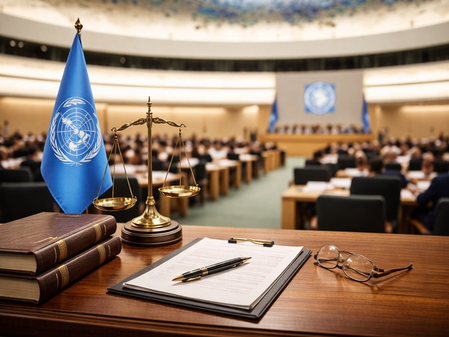
Jaipur, Feb 25 (IANS) Rajasthan-based non-governmental organisation (NGO) Sambhali Trust has urged the international community to move beyond symbolic commitments and ensure that human rights are fully integrated as a core and actionable principle in governance, policymaking, and development processes worldwide.
Addressing the Annual High-Level Panel Discussion on Human Rights Mainstreaming during the 61st session of the United Nations Human Rights Council (UNHRC) in Geneva, Hansraj Singh, representing Sambhali Trust, emphasised that human rights must be transformed from theoretical commitments into practical and operational priorities across policies, institutions, and implementation frameworks at national and international levels.
“Human rights mainstreaming must not remain a theoretical commitment but should function as a cross-cutting principle integrated into policies, institutions, and implementation frameworks,” Singh said while presenting the organisation’s perspective at the global forum.
The 61st session of the UNHRC is currently being held in Geneva from February 23 to March 31, 2026, bringing together representatives from member states, civil society organisations, and international bodies to deliberate on pressing human rights issues.
During his intervention, Singh highlighted India’s constitutional safeguards, progressive legislative framework, and various welfare schemes as important examples of efforts to integrate human rights principles into national governance and development initiatives.
Among the key initiatives cited were Mission Vatsalya, which focuses on child protection, care, and holistic development with emphasis on family-based care and support systems for vulnerable children.
He also referred to POSHAN Abhiyaan, India’s flagship National Nutrition Mission, which aims to improve nutritional outcomes for children, pregnant women, lactating mothers, and adolescent girls across the country.
Singh further highlighted the Pradhan Mantri Awas Yojana, a major housing initiative designed to provide affordable housing to economically weaker sections, thereby promoting dignity, security, and improved living conditions.
He also emphasised the importance of Digital India programmes aimed at bridging the digital divide and enhancing access to essential services.
These initiatives include PMGDISHA (Pradhan Mantri Gramin Digital Saksharta Abhiyan), which promotes digital literacy in rural households, BharatNet, which aims to expand high-speed broadband connectivity in rural areas, Aadhaar, the world’s largest biometric digital identity system enabling access to government services, and DIKSHA, a national digital learning platform delivering educational resources across the country.
Singh noted that such programmes reflect deliberate and sustained efforts to integrate principles of dignity, equality, and justice into India’s development agenda, in alignment with the United Nations Sustainable Development Goals (SDGs).
Sambhali Trust’s participation in the UNHRC session reflects the growing contribution of civil society organisations from the Global South in shaping global human rights discourse and policy engagement.
By bringing grassroots perspectives and field-level experiences to the international platform, the organisation contributed meaningfully to discussions on making human rights a lived and actionable reality rather than an abstract or symbolic principle.
The 61st UNHRC session is currently deliberating on several key issues, including the protection of human rights defenders, economic, social, and cultural rights, strengthening international cooperation, and reinforcing the global human rights architecture.
Experts noted that inputs from grassroots organisations such as Sambhali Trust help enrich UNHRC discussions by demonstrating how local initiatives and community-level interventions can inform global human rights policy frameworks and implementation strategies.
Their intervention underscored the importance of translating human rights commitments into tangible action at community, national, and international levels.
The session will continue in Geneva with further deliberations, panel discussions, adoption of resolutions, and policy outcomes expected in the coming weeks.
–IANS
arc/pgh