
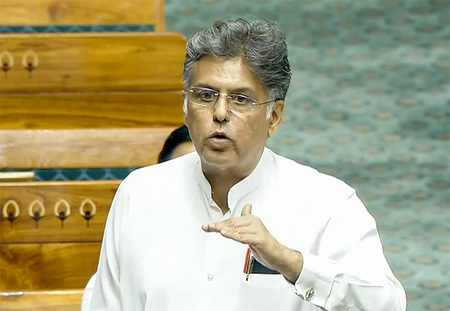
Chandigarh, Aug 6 (IANS) Punjab’s debt servicing cost, interest plus principal repayment, is in the range of about Rs 42,481 crore, or “more than 23 per cent of the state revenues”, Congress MP Manish Tewari said on Thursday.
“It means for every one rupee of revenue generation by Punjab 23 paisa go towards only debt servicing — the revenue expenditure minus debt servicing is at 71.4 per cent”, the three-time Member of Parliament and former Union Minister Information and Broadcasting wrote on X
“What is then left for Capital Expenditure — development expenditure that creates capital assets 5.6 per cent? Is this a sustainable model?” said Tewari, who attended the Parliamentary Standing Committee meeting to review the long-term public finance and debt at the Centre and the states.
“The politicians of Punjab should really think hard?”.
The Congress lawmaker from Chandigarh further wrote: “Probably you have not looked at the debt to GDP and debt to GDSP ratio’s of Central and state governments because of COVID-19 between FY 2019 -2020 and 2022-23.”
“One number would suffice fiscal deficit as a percentage of GDP for the Union Government went up from 4.6 per cent to 9.2 per cent. In Punjab also @INCPunjab government also had to deal with COVID-19 that is why Punjab’s debt to GSDP went up from 36.2 per cent in 2019 -20 to 41.3 per cent it then moderated after that marginally before going up to 39.9 per cent in 2024-25.”
A day earlier, state Bharatiya Janata Party (BJP) President Kewal Singh Dhillon slammed the Aam Aadmi Party government, alleging the state was witnessing an “administrative emergency” due to its failure to fulfil financial commitments made to government employees.
Dhillon said that before coming to power, the AAP had made several promises to employees, assuring them that their long-pending issues would be resolved.
However, after assuming office, the government allegedly failed to honour those commitments, leaving employees with no option but to resort to protests and strikes.
Questioning the government’s functioning, Dhillon asked how essential public services could continue uninterrupted when employees from so many critical departments were on strike. He said the government’s failure to engage with employees and address their grievances had pushed the state’s administrative machinery towards paralysis. He remarked that citizens were being forced to run from one government office to another for even routine work. Healthcare, education, power-related services and several essential administrative functions had been severely disrupted, he alleged.
–IANS
vg/vd