
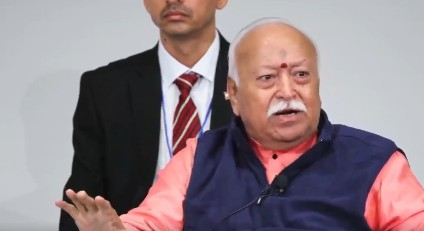
New York, Aug 30 (IANS) Rashtriya Swayamsevak Sangh (RSS) Chief Mohan Bhagwat has said that knowledge alone cannot overcome religious and social divisions, calling for sustained practices that make service, love and respect part of everyday human behaviour.
Speaking at the “One World, One Humanity” programme in New York, Bhagwat added that traditions around the world already contained the knowledge needed to promote peace and unity.
“The problem is not knowledge of human beings,” he said.
“In our knowledge, traditional knowledge, all over the world, every society in its tradition has this knowledge somewhere.”
The challenge, the RSS Chief said, was to create conditions in which that wisdom guided human conduct.
“But now we have to create a situation wherein this knowledge prevails. And this knowledge rules the human behaviour,” Bhagwat said.
“Knowledge of goodness. Knowledge of love. That we have to do.”
He said that people often knew the right course but acted differently because of personal preferences and temptations.
Using his own diabetes as an example, Bhagwat said he knew that he should avoid sugar but could still find excuses to eat sweets.
“I know everything,” he said.
“But still, when that comes, I say, oh, once I find it, it is all right. I find excuses. I do it.”
Human beings behaved similarly despite knowing that religious leaders were offering the right message, Bhagwat added.
Intellectual education by itself could not overcome deeply embedded habits.
“This is a matter not of educating them, intellect twice,” Bhagwat said.
“We have to instill the practice.”
Religious rituals could help build those habits because they taught people to give, the RSS Chief added.
“Rituals of all religions teach the practice of giving,” Bhagwat said.
The RSS Chief cited Ramakrishna Paramahamsa, the spiritual teacher of Swami Vivekananda, who studied and practised multiple religious traditions, including Islam and Christianity.
“He (Ramakrishna Paramahamsa) practiced all the religions,” Bhagwat said.
“Those of Bharatiya origin and also Islam and Christianity.”
Bhagwat said Ramakrishna’s conclusion was that different faiths led towards the same destination.
“And then he told us, don’t worry. As many ways, as many thoughts. But all lead to one goal,” he said.
“That is not theory. Real experience.”
He also referred to philosopher and academic R.D. Ranade, who studied mystical traditions across different faiths and cultures.
“He tells that whatever the path, the experience people get are strikingly similar,” Bhagwat said.
“There are documented experiences. He has studied all those.”
Such teachings, the RSS Chief said, needed to reach ordinary people.
“Individuals must recognise that personal change was necessary before society could resist the desire for material gain, influence and superiority.”
“Habit should be changed so radically and new habit should be so strong that it should fight this deflection of the lure of material happiness,” he said.
Bhagwat urged religious leaders to continue their work even when visible progress was slow.
The task would be difficult, he said, but abandoning it could allow humanity to return to conflict.
The Ramakrishna movement traces its spiritual foundation to Ramakrishna Paramahamsa, a 19th-century mystic whose teachings influenced Swami Vivekananda.
Vivekananda introduced Vedanta and yoga to a wider Western audience during his 1893 address in Chicago.
Bhagwat has led the Rashtriya Swayamsevak Sangh since 2009. The organisation was founded in Nagpur in 1925 and marked its centenary in 2025.
–IANS
int/lkj/khz