
New Delhi, May 16 (IANS) Twelve years ago, this day, on May 16, 2014, electors of India delivered a clear mandate to elect a stable government of the National Democratic Alliance (NDA) led by the Bharatiya Janata Party (BJP) under Prime Minister Narendra Modi.
It was a vote against alleged corrupt practises and reported coalition frictions during the Congress-led United Progressive Alliance (UPA) regime.
That day “something special happened”, according to the Prime Minister himself.
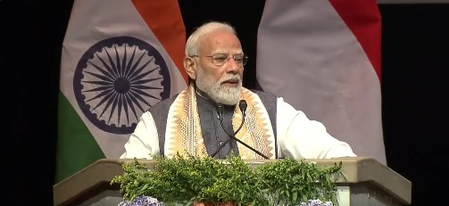
“On this very day in 2014, the results of the Lok Sabha elections were announced. After decades, a stable and full majority government was set to be formed in India. From that day to this, the immense belief of the Indians has not let me stop or get tired. This is ongoing nonstop,” PM Modi said on Saturday, addressing a huge gathering of the Indian diaspora at The Hague during his visit to the Netherlands.
India stepped into a new political era as Narendra Modi, the then Chief Minister of Gujarat, was sworn in as the 14th Prime Minister of India.
Today, his tenure is widely viewed not just as a longevity record, but as a period of sweeping structural reforms, assertive governance, and a recalibrated place for India in the global order.
“I am a small man who wants to do big things”, underlines Prime Minister Modi’s life, of rising from humble beginnings to serving India and its citizens.
Narendra Modi’s first term as the country’s Prime Minister was marked by mission‑style programmes that sought to deepen financial inclusion and modernise the economy.
The Pradhan Mantri Jan Dhan Yojana (PMJDY), launched in 2014, opened more than 500 million bank accounts for the poor, bringing millions into the formal financial system.
It was “Sabka Saath, Sabka Vikas, Sabka Vishwas” (together with all, progress for all, trust of all) became the slogan of his governance, emphasising inclusivity and collective development.
This was followed by the “Digital India” push, which expanded internet connectivity, digital payments, and e‑governance stacks, including Aadhaar‑linked Direct Benefit Transfer (DBT), reducing leakages and ensuring subsidies reached intended beneficiaries.
“I dream of a Digital India where knowledge is strength — and empowers the people”, reflected the vision behind Aadhaar, UPI, and digital‑governance platforms.
In 2016, the rollout of the Goods and Services Tax (GST) unified India’s patchwork of indirect taxes into a single, pan‑India regime, creating a common market and simplifying compliance for businesses.
The Narendra Modi government also introduced schemes such as ‘Startup India’ and ‘Make in India’ to boost entrepreneurship and manufacturing, while later reforms like production‑linked incentives (PLIs) and eased foreign‑direct‑investment norms helped position India as a global manufacturing alternative.
On the social‑welfare front, flagship programmes like Ayushman Bharat — world’s largest publicly funded health‑insurance scheme — and the Pradhan Mantri Garib Kalyan Anna Yojana — which provided free foodgrains to hundreds of millions during the pandemic — became central to the narrative of “pro‑poor, pro‑middle class” development.
Income‑tax relief and moves such as raising the tax‑free slab for middle‑income earners also helped reshape the fiscal compact with salaried India.
The era has been distinguished by a strong approach to national security and internal cohesion with a harder line against cross‑border terrorism, including the Balakot air strikes in 2019, which symbolised a shift toward proactive deterrence.
Emphasis on “minimum government, maximum governance” translated into e‑governance platforms, time‑bound clearances, and the PM Gati Shakti infrastructure‑planning framework, which seeks to synchronise road, rail, port, and logistics projects across Ministries.
Under Prime Minister Modi, India has pursued a more visible and multipolar diplomacy, balancing ties with diverse nations while expanding global strategic partnerships.
India’s role in global supply‑chain diversification, the “Brand India” narrative, and the Prime Minister’s personal connect with overseas diasporas have helped burnish the country’s image as an emerging global power.
Additionally, his government has been instrumental in implementing various initiatives that empower youth, women, and farmers in India.
Meanwhile, the BJP leveraged PM Modi’s appeal and the idea of “double engine” governance to extend its footprint beyond the Hindi heartland.
State‑level consolidation reinforced the sense of a “national” BJP.
“I challenge the challenges. I like to face the problems”, a line PM Modi has often used to project personal resolve in the face of crises built a distinct image of a work‑centric, goal‑oriented leader.
The last 12 years is recounted for a mix of bold policy strokes, assertive governance, and a re‑imagined role for India in the world.
–IANS
jb/khz