
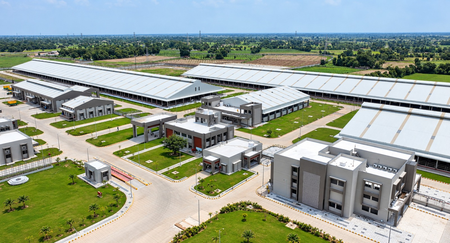
Palanpur (Gujarat), Oct 27 (IANS) Prime Minister Narendra Modi will inaugurate a Rs 325-crore cattle breeding and research centre at Bhildi in Gujarat’s Banaskantha district on October 30, with the facility aiming to produce 25,000 superior embryos annually to improve indigenous cattle breeds and increase milk production.
The Bharat Bovine Breeding and Research Centre (BBBRC), spread across 127 acres, has been developed by Banas Dairy with technical guidance from the National Dairy Development Board (NDDB) and support under the Centre’s ‘Rashtriya Gokul Mission’.
It is among five major development projects of Banas Dairy that PM Modi will inaugurate or dedicate to the public, or for which he will lay foundation stones, during his visit.
State Assembly Speaker and Banas Dairy Chairman Shankar Chaudhary said the centre would use advanced reproductive technologies, including ovum pick-up and in-vitro fertilisation (OPU-IVF), as well as embryo transfer, to increase the breeding of high-quality cattle.
“Normally, a cow of a superior breed gives birth to only one calf in a year. However, with the help of this new technology, several calves can be obtained from an elite cow within a single year,” Chaudhary said.
The centre has set a target of producing 25,000 superior embryos annually. The initiative is intended to improve the genetic quality of successive generations of cattle and enhance their milk-producing capacity.
The facility will focus on indigenous cattle breeds, including Kankrej, Gir, Sahiwal and Tharparkar, as well as buffalo breeds such as Mehsani, Banni, Jaffarabadi and Murrah.
Chaudhary said the centre’s approach is to promote “fewer animals, but better-quality animals and more milk”, particularly as livestock farmers face shrinking fodder-growing areas and rising rearing costs.
The initiative is expected to benefit small livestock farmers and rural women, who, according to Banas Dairy, contribute 70 per cent of the work in the dairy sector.
Disease-free bulls of superior breeds, quality semen and embryos at affordable rates will be made available to livestock farmers. The improved genetic potential of animals is expected to help increase milk yields and reduce production costs.
Higher milk-fat content could also improve returns for farmers, although the outcomes will depend on the animals, their feeding and management, and the adoption of the breeding technologies.
The centre is also expected to promote Indian cattle breeds internationally. Indigenous cows and buffaloes are valued for their ability to withstand heat and, in suitable conditions, produce milk with comparatively lower feed requirements.
Banas Dairy, a farmers’ cooperative, has developed the facility with expert guidance and government support. The centre is intended to strengthen scientific breeding practices and improve the productivity and profitability of livestock rearing.
–IANS
mys/uk