
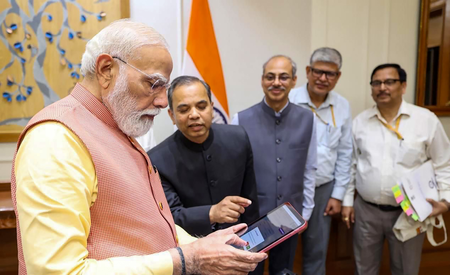
New Delhi, April 1 (IANS) Prime Minister Narendra Modi on Wednesday completed his self-enumeration for Census 2027, marking the start of the first phase of India’s first fully digital census exercise.
In a post on X, the Prime Minister said: “Completed my self-enumeration. Today marks the beginning of the first phase of Census 2027, relating to house listing and housing operations. This census is the first time data collection is being done through digital means. It also empowers the people of India to self-enumerate their household details. I appeal to the people of India to self-enumerate their household details themselves and participate in the Census process.”
The exercise is significant as Census 2027 will be India’s first fully digital census, moving away from the traditional paper-based system followed for over 150 years. It is being conducted in two phases under the Census Act, 1948.
The first phase — House Listing and Housing Census (HLO) — focuses on collecting data on housing conditions, assets, amenities and household details through 33 notified questions.
A key feature is the introduction of self-enumeration, allowing citizens to voluntarily submit their household information online through a dedicated portal. This 15-day window precedes door-to-door enumeration in each state and Union Territory, aiming to improve accuracy, reduce errors and encourage wider participation.
The portal supports multiple languages, including English, Hindi and 14 regional languages.
The first phase of house listing will be rolled out between April and September 2026 in a staggered manner across states. In several regions, including parts of Delhi (NDMC and Delhi Cantonment), Andaman and Nicobar Islands, Goa, Karnataka, Lakshadweep, Mizoram, Odisha and Sikkim, self-enumeration is open from April 1 to April 15, followed by house-to-house listing from April 16 to May 15. Other states will follow similar 15-day windows aligned with their schedules.
The second phase, covering population enumeration, is scheduled for early 2027, with March 1, 2027 fixed as the reference date.
The census is also expected to include caste enumeration for the first time since 1931, making it a significant exercise for policy planning, welfare schemes, resource allocation and development strategies.
Prime Minister Modi’s participation and appeal are being seen as a push to promote digital adoption and ensure wider coverage. Officials have said that robust data security measures are in place, with data centres designated as critical information infrastructure and information to be used only for statistical purposes.
After a gap since the last census in 2011, the digital approach is expected to deliver faster and more reliable data, supporting governance and planning. The government has also released 33 FAQs to guide citizens, emphasising that no documents are required for self-enumeration.
–IANS
sktr/pgh