
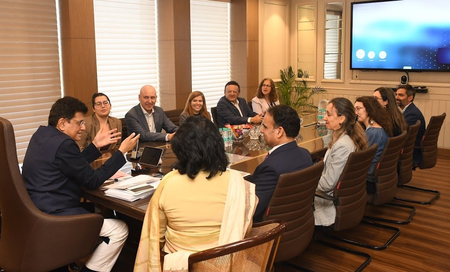
New Delhi, Feb 25 (IANS) Commerce and Industry Minister Piyush Goyal on Wednesday said that he has held talks on the India-Israel free trade agreement with a high-level Israeli delegation.
“I had a productive interaction with the Israeli team, reflecting our shared commitment to deepening economic engagement. It is encouraging to see both sides working closely to unlock new opportunities in trade, innovation and growth, further strengthening our valued partnership,” Goyal said in a post on X.
“As our leaders, Prime Minister Narendra Modi and Prime Minister Netanyahu meet, their shared vision is steadily translating into action, with the Israeli delegation in New Delhi advancing the India-Israel Free Trade Agreement negotiations,” he wrote.
Goyal’s response came as Israel’s Minister of Economy and Industry Nir Barkat posted: “A delegation led by the Foreign Trade Administration at the Ministry of Economy and Industry has arrived in India to launch negotiations for a Free Trade Agreement between our nations.”
“Thanks to the strategic relationship between our leaders, Prime Ministers Netanyahu and Narendra Modi , and the friendship I have forged with Piyush, we are on the way to a breakthrough that creates great new opportunities between our countries and will serve as a powerful growth engine for the economies of Israel and India.”
The Terms of Reference (ToR) for the FTA negotiations were signed in November 2025, establishing a structured framework for discussions on identified areas to enhance trade and economic cooperation.
Total merchandise trade between India and Israel stood at $3.62 billion in FY 2024-2025. The two countries share complementarities across several sectors, and the FTA will be a catalyst to further enhance the bilateral trade by providing certainty and predictability to businesses, including MSMEs.
During this round, technical experts from both sides are engaging in sessions covering various aspects of FTA, such as trade in goods, trade in services, rules of origin, sanitary and phytosanitary measures, technical barriers to trade, customs procedure and trade facilitation, intellectual property rights, among others.
–IANS
sps/vd