
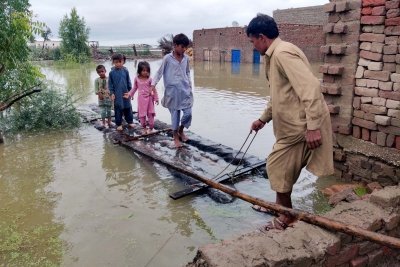
Islamabad, June 8 (IANS) As Pakistan continues to face multiple climate related issues like melting glaciers in the north, rising seas in the south, choking smog in Punjab and water shortage in Balochistan and Karachi, the country’s ecological stresses are colliding with rapid population growth, poor governance and outdated infrastructure, a report has stated.
The situation raises question on whether the Pakistani authorities and the society can recognise the scale of the danger and respond before a crisis becomes collapse. Pakistan is one of the most vulnerable countries on the planet when it comes to facing the consequences of the climate and ecologies emergency. Each city of Pakistan faces a unique threat with regards to the climate crisis, according to a report in The Express Tribune magazine.
“An unfolding national security, public health, and survival challenge – Pakistan’s climate crisis is no longer a distant environmental warning. From melting glaciers in the north to rising seas in the south, from choking smog in Punjab to chronic water scarcity in Balochistan and Karachi, the country’s ecological stresses are colliding with rapid population growth, poor governance, and outdated infrastructure,” climate activist Zain Haq mentioned in a report in The Express Tribune.
“The consequences are not abstract. They threaten the most basic foundations of human life: food, water, shelter, energy, and breathable air. While Pakistan’s contribution to global emissions remains relatively small, its vulnerability is immense — and vulnerability does not absolve responsibility,” Haq added.
Google search reveals that the ground water supply of Quetta has depleted sharply since the late 1990s. According to the International Union for Conservation of Nature, as reported in multiple publications a few years back, it was just 50 metres below the surface in the area around Quetta at the start of the century, while today one has to dig at least 150 metres before coming across water. According to the organisation, the water supply is also reduced by 2-5 metres each year, posing existential threat to Quetta’s consistently rising population.
Climate crisis is also causing increase in temperatures. The global average increase is currently at 1.5 degrees and for coastal cities like Quetta and Lahore, a two degrees increase in global average temperatures could mean a five degrees average increase, implying that temperature in Quetta would reach 41-46 degrees during summers within the next 10-15 years.
Pakistan is also facing water shortage as Karachi, unlike parts of Punjab, does not have underground water storage. The government has claimed to work on the K4 plan to supply water to Karachi from Keenjhar lake, a project that was scheduled to be completed by 2019, however, still has not been completed as of yet.
“The other crisis that Karachi faces is that of an impending food shortage and crisis. In the 2023 floods, Pakistan lost 90% of its crops, which in part worsened inflation in the country. For 2026, the National Disaster Management Agency has claimed that the monsoon is supposed to be 26 per cent worse compared to last year,” the report in Express Tribune magazine stated.
“This trend is predicted to worsen over the coming decades. Cities do not grow their own food and rely on the country-side to provide them with food. However, with an increasingly unstable and unpredictable climate and weather patterns, food production could be seriously disrupted. We have already seen a universal increase in food prices, in part due to climate change, in addition to the war on Ukraine,” it added.
–IANS
akl/as