
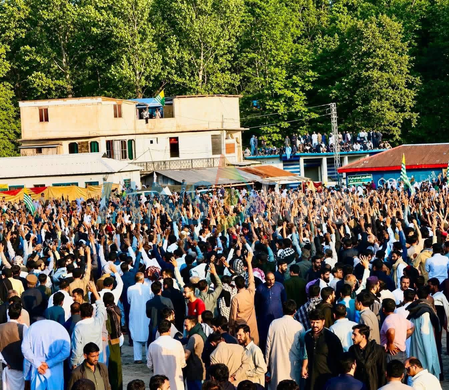
New Delhi, July 1 (IANS) There is panic and anxiety within Pakistan’s establishment with the protests in Pakistan-occupied-Kashmir (PoK) continuing unabated despite a massive crackdown. After using brute force against the protesters, the establishment now hopes that these people can be demoralised if top-level arrests are made.
The arrest of Shaukat Nawaz Mir, a prominent voice in PoK and a top leader of the Joint Awami Action Committee (JAAC) was meant to deter the protesters.
Mir was picked up in a coordinated operation by the Intelligence, local police and Pakistan Rangers before being shifted to Rawalpindi.
An Intelligence Bureau official said that there appears to be a shift in strategy by Pakistan.
The numerous forced disappearances, firing at the protesters including women and children and threats have not worked. In fact these actions have only increased the resolve of the people of PoK, who have only intensified their protests.
The establishment now feels that arresting the top leaders would demoralise the people and the protests may gradually fizzle out, like in the past, the official said.
Another official said that it is not just the arrest of Mir that was meant to send out a message. The fact that they shifted him to Rawalpindi where he would be under the direct watch of the military is also meant to send a signal of what is to come if the protesters do not fall in line.
The JAAC has, however, made it clear that no amount of force or threats will bog them down. The protests will continue even if there is no leader, the JAAC has said while making it clear that it is not a protest by some organisation, but by the people.
While Mir has been taken into custody, the establishment has been charging many other leaders under the anti-terrorism laws.
The establishment wants to suggest to the world that it is not fighting mere dissent by the public, but the war is against terrorists, an official said.
The people of PoK have been demanding wheat subsidies, fair pricing where electricity is concerned and an end to exploitation of their resources. The establishment has, however, remained defiant and has not fulfilled any of these demands.
Another official said that the Pakistan establishment hoped that the protests would die down like they did in the past. However, things have not gone exactly as per plan and the establishment is staring at a crisis in PoK like it has never seen before, the official added.
What has irked the establishment more is that the people of the region are now declaring that they are not part of Pakistan anymore. They have been seeking independence from Pakistan.
This development comes in the backdrop of Pakistan’s Defence Minister Khawaja Asif saying that the people of Rawalot and Mirpur were not proper Kashmiris. This has not gone down well with the people of the region and has only signalled that the rift has become much bigger, officials say.
Officials say that it is not just the people of PoK, but many within Pakistan, too, are questioning the stand taken by the establishment. It is not just PoK, but the whole of Pakistan has been facing a severe economic crisis and this has only added to the heap of questions that is being asked of the establishment, officials say.
The Pakistan establishment feels that it is now time for a major diversion and hence is looking to get India into the picture and project New Delhi as the aggressor.
The establishment has accused India of backing the protests, a claim that has not been taken seriously by anyone.
Over the last couple of days, Pakistan has tried to shift the focus to the Indus Water Treaty (IWT). The aim is to build up a global narrative and drag India into this issue. It wants to project to the world that India is indulging in ‘water terrorism’ after it placed the treaty under abeyance last year post the Pahalgam terror attack by Pakistan-based militants in which 26 people were killed.
An official said that the aim is to divert attention from its own problems, especially in PoK, and the economic situation in the country.
Pakistan wants to convey to its people that all the problems it is facing are only because the IWT was kept in abeyance.
An official said that Pakistan would not look to address issues such as water mismanagement, failing canal networks and poorly maintained dams.
The official said that projects such as the Diamer-Bhasha and Dasu dam have been severely affected due to financial constraints and this is something that the people of Pakistan will not be told about.
–IANS
vn/rad