
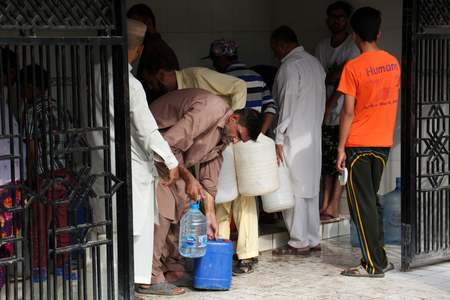
Islamabad, July 19 (IANS) The water dispute between Pakistan’s provinces of Sindh and Balochistan escalated as three Balochistan ministers participated in a farmers’ protest at Sukkur Barrage, accusing Sindh of diverting their allocated share of water and stressed that farmers are facing financial stress due to prolonged shortages, local media reported on Sunday.
The ministers called on the Sindh government to act against what they termed the theft of Balochistan’s water share through unauthorised channels in Sindh. Farmers from several parts of Larkana division and their counterparts from Balochistan on Saturday held protest over alleged water shortages, Pakistan-based The Express Tribune reported.
Balochistan Chief Minister Sarfaraz Bugti has formed a committee comprising ministers – Muhammad Sadiq Umrani, Saleem Ahmed Khoso and Muhammad Khan Lehri, to raise water concerns of the province with the Sindh government.
Speaking to protesters, Muhammad Sadiq Umrani said Balochistan wanted its water share to be ensured under the 1991 Water Accord and said that the province was not getting its allocated share of 2,400 cusecs from Khirthar Canal and 6,700 cusecs from Pat Feeder.
Umrani said that farmers were getting severely impacted in Balochistan as they were not able to get water at crucial crop sowing periods, which will lead to financial losses, The Express Tribune reported.
Saleem Ahmed Khoso said Sindh Irrigation officials had claimed that Balochistan was getting more water than its allocated share, however, the committee rejected this claim. He said that ground realities showed a shortage of water and stated that Balochistan wanted a permanent solution to the issue so that it does not lead to repeated protests each year.
Earlier this year, a report highlighted that a major water crisis was unfolding in Balochistan, along with a demographic explosion that threatens to overwhelm the fragile ecology of the province.
“Every morning in Quetta, before the sun clears the jagged peaks of the Sulaiman Mountains, a ritual of anxiety begins. It starts with the hollow, metallic clink of a dry tap. For thousands of households, this sound is the starting gun for a daily race for survival. With it echo the neighbourhoods with one question: ‘Will water come today?'” a report in the Express Tribune magazine stated.
“In the sprawling neighbourhoods of the provincial capital, families ration every drop, calculating whether a litre of water should be used for cooking a meal or washing a child’s face. What was once a seasonal inconvenience has hardened into a defining feature of life in Balochistan. This quiet crisis is unfolding alongside a demographic explosion that threatens to overwhelm the province’s fragile ecology,” it added.
According to Population Management and Communication Team (PMCT) Director Abdul Sattar Shahwani, the population of Balochistan has increased to 14.89 million, up from 12.34 million in 2017, showcasing an average annual growth rate of 3.2 per cent. Official projections suggest that Balochistan will have a population of 18.57 million people by 2030, and the figure could be over 35 million by 2050.
“We are adding millions of people to a landscape that is physically losing its ability to support life,” the report quoted a local urban planning consultant as saying.
“If the population doubles while the water table halves, the math simply doesn’t work. We are heading toward an impossibility.”
For decades, Balochistan survived on its groundwater; however, the account is now overdrawn. The World Bank stated that 95 per cent of Balochistan’s farmland depends on groundwater extraction. Only five per cent of Balochistan is linked to the Indus Basin’s canal system. This over-dependence has turned a lifeline into a liability.
–IANS
akl/rs